Animals in groups obtain information from social partners to engage in adaptive behaviour1,2,3. Social information transmission is observed in fish schools4,5,6, bird flocks7,8 and human groups9,10, but the neural representation of such socially acquired information is poorly understood3,11,12. Here we show that, in the schooling glassfish Danionella cerebrum13,14,15, collective escape from danger can be mediated by an individual’s visual perception of other escaping animals.
To understand the neural basis of socially transmitted escape behaviour, we imaged neural activity from adult glassfish viewing the actions of virtual conspecifics. Visual neurons in the midbrain optic tectum16,17 and thalamus18 increased their activity when virtual conspecifics escaped. Escape-responsive neurons also responded to the sudden disappearance of virtual fish, yet were unaffected by the disappearance of stimuli moving with non-biological linear motion.
Behaviourally, fish retreated from virtual schools that escaped or disappeared, but only those swimming with biological burst-and-glide motion. Neural encoding of this rapid social offset allows fish to infer danger from social information alone, a potentially effective strategy for animals that are capable of rapid movement but have a limited visual range14,19. These results show how the neural computations of individuals enable rapid information sharing in collectives.
Living in groups provides animals with a variety of advantages, including protection from danger and predation1,2,3,4,5,6,7,8. In fish schools and bird flocks, an approaching predator or other threatening stimulus can drive collective escape and avoidance behaviours5,6,20,21,22,23,24. Individuals in these groups need not directly sense the threat to avoid danger if they act in response to the movements of their threat-informed neighbours, a benefit of collective living referred to as the ‘many eyes effect’25,26.
Despite the prevalence of collective movement and predator avoidance in nature1,2,3,22,27, little is known about the neural mechanisms that allow individuals to obtain relevant, actionable information from their partners3,11,12. The neural basis of social recognition has been characterized in a variety of invertebrate and vertebrate species15,18,28,29,30,31, but it remains unclear how individuals recognize the specific actions of their social partners to engage in adaptive behaviour that benefits the individual and the group. We address this question by studying the brain and behaviour of D. cerebrum, a micro glassfish that engages in collective schooling behaviour using visual perception of social partners13,15,32 and that is amenable to large-scale in vivo neural activity imaging15,33,34,35.
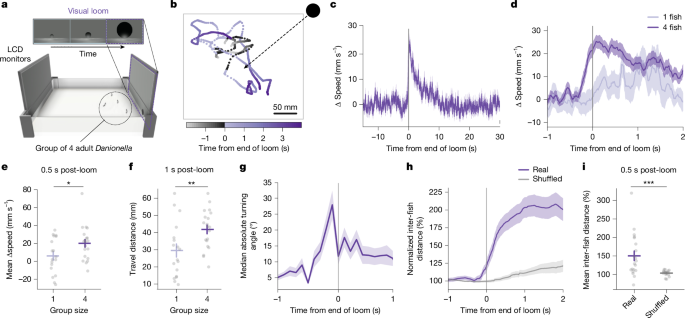
This model system provides us with experimental access to the sensory cues and neural circuits that underlie social information transmission during collective responses to threats. Here we examine the perceptual and neural basis of collective escape behaviours in adult D. cerebrum and identify a neural signature of social action detection in central visual circuits that engages escape behaviour in observers to produce collective threat avoidance. We first characterized the escape behaviour of adult D. cerebrum in groups of four by measuring the positions and postures of fish responding to a looming visual object, which mimics an approaching predator (Extended Data Fig. 1a,b and Methods).
Extract — continue reading at the source.


