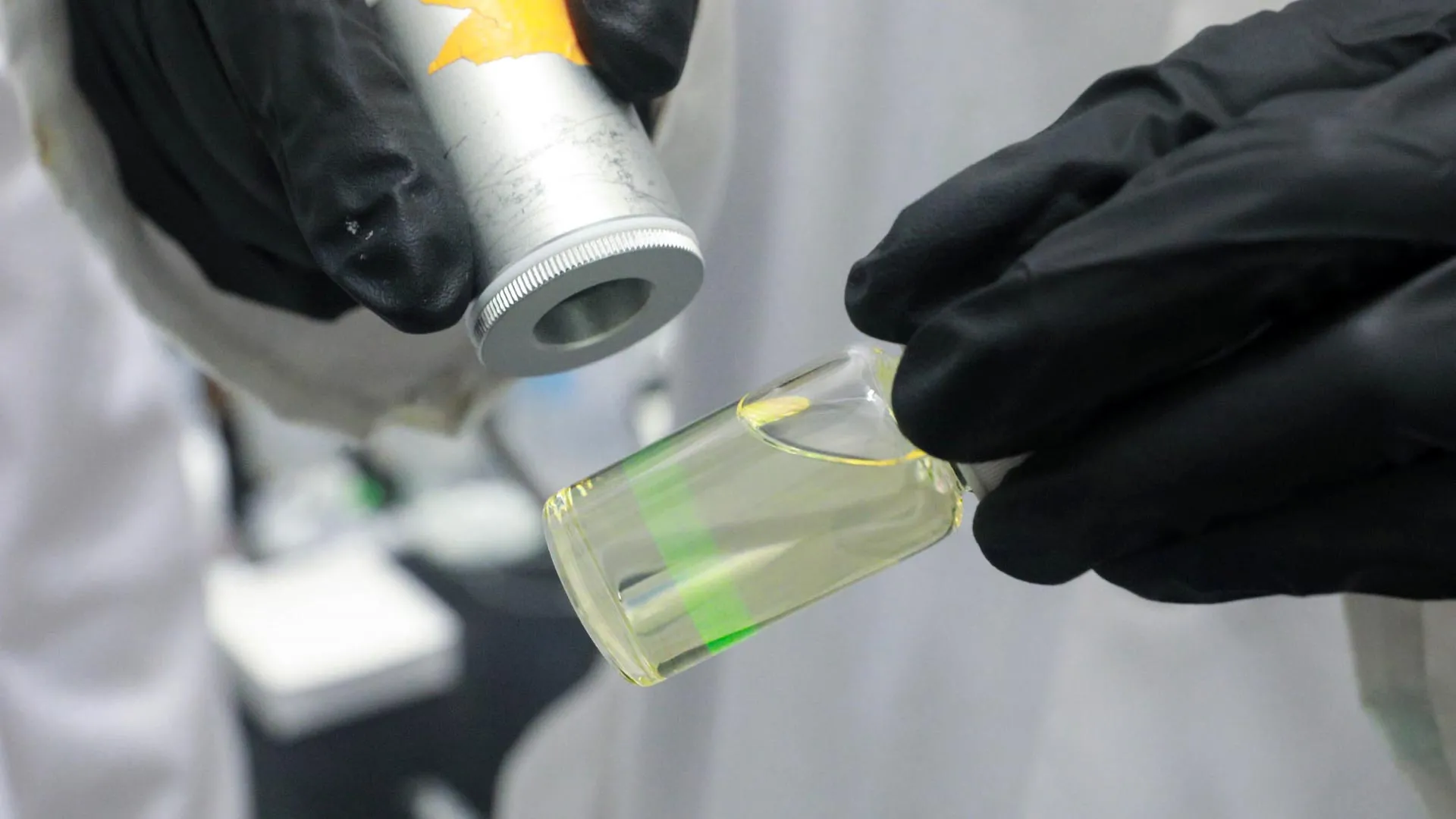
Engineers at the University of Toronto have developed a new type of dye-sensitized nanoparticle that can detect chemicals at extremely low concentrations while also telling apart molecules that are nearly identical in shape. The tiny particles produce a light signal after attaching to the chemical they are designed to detect. They absorb low-energy photons and convert that energy into higher-energy photons, creating a bright optical signal that researchers can measure.
That unusual ability could have practical uses in several fields. Pharmaceutical manufacturers, for example, could use the particles to identify unwanted impurities in drugs. Environmental researchers could potentially use them to search for very small amounts of chemical pollutants in groundwater.
Turning Infrared Light Into a Bright Green Signal "Organic molecules called fluorophores have been used for decades to absorb light and convert it into colorful emissions, but the process only works in one direction," says Professor Kai Huang, senior author on a paper published in the Journal of the American Chemical Society that describes the new particles. "With fluorophores, the excitation frequency has to be higher than the emission frequency, which means that they convert high-energy photons into low-energy photons. What makes our dye-sensitized nanoparticles special is that they are capable of upconversion, meaning that they can absorb light in the form of low-energy photons and emit higher-energy ones.
"For example, you could excite them with near-infrared light, which can easily be produced with low-cost lasers, and they would glow bright green in response." This process, known as upconversion, gives the nanoparticles an important advantage. Because the light used to activate them has a different frequency from the light they emit, researchers can separate the desired signal more easily from background light generated by the sample itself. Huang compares the effect to looking at the night sky.
"It's like the difference between stargazing at night versus the daytime," he says. "The stars shine the same brightness all the time, but during the day the sun is so powerful that it overwhelms them. Shifting the excitation frequency lower produces zero-autofluorescence background in the samples you are analyzing, while the luminescent nanoprobes keep shining; it is like turning off the sun, so you can see the stars better." The Challenge of Making Nanoparticles Brighter The particles rely on ions of ytterbium and erbium, which belong to the lanthanide family of chemical elements, to carry out the upconversion process.
Earlier versions of these sensing nanoparticles were typically made as flat hexagonal structures. Ytterbium and erbium ions were distributed through a host material made from sodium, yttrium and fluorine. The researchers compare this arrangement to chocolate chips embedded in a cookie, while organic dye molecules covering the outside resemble icing.
Extract — continue reading at the source.