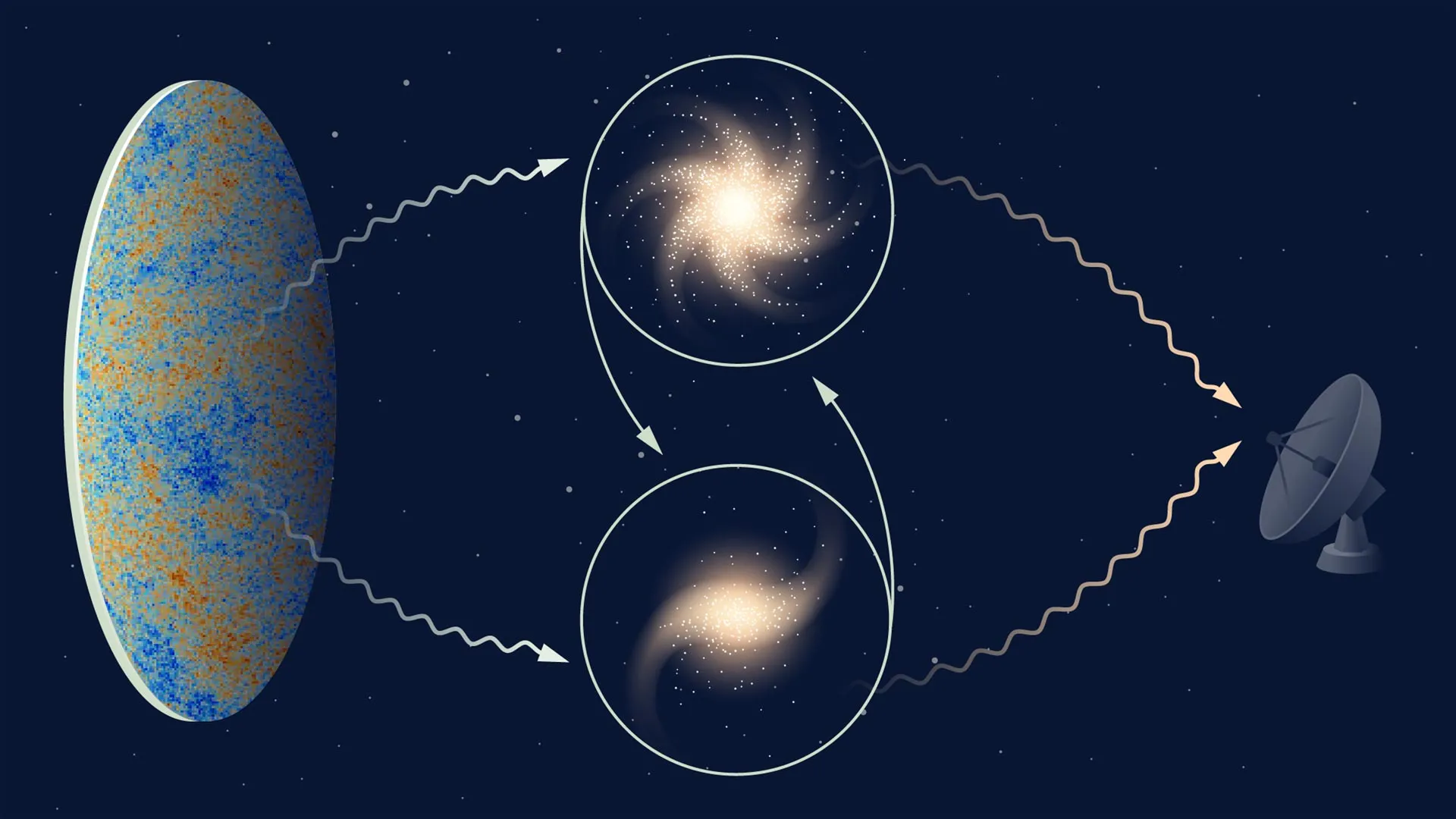
Gravity is best known as the force that pulls objects toward Earth, but its role extends far beyond falling apples. Across the universe, gravity acts as an invisible framework that influences how galaxies, galaxy clusters, and the largest cosmic structures form and evolve. For decades, however, astronomers have faced observations that do not seem to fit neatly with what can be seen.
Some stars and galaxies move much faster than their visible mass appears capable of explaining. That mystery has led cosmologists such as University of Pennsylvania researcher Patricio A. Gallardo to investigate whether the laws of gravity established by Isaac Newton and Albert Einstein remain valid everywhere in the universe.
"Astrophysics has been plagued by a massive discrepancy in the cosmic ledger," says Gallardo. "When we look at how stars orbit within galaxies or how galaxies move within galaxy clusters, some appear to be traveling way too fast for the amount of visible matter they contain." According to Gallardo, this discrepancy points toward two dramatically different possibilities. The universe may contain large amounts of invisible "dark matter" whose gravity supplies the additional pull, or "the fundamental equations for gravity need to be modified." Testing Gravity on Unprecedented Cosmic Scales Gallardo and his collaborators have now put gravity to an unusually large test using observations from the Atacama Cosmology Telescope (ACT), a telescope roughly three to four stories tall that was developed largely by Penn researchers led by Mark Devlin.
The team examined gravity across galaxy clusters separated by hundreds of millions of light-years, making this the largest-scale test of gravity performed so far. The results, published in Physical Review Letters, show that the strength of gravity decreases with distance almost exactly as predicted by Newton's equations and later incorporated into Einstein's theory of general relativity. "It is remarkable that the law of the inverse of the squares -- proposed by Newton in the 17th century and then incorporated by Einstein's theory of general relativity -- is still holding its ground in the 21st century," says Gallardo.
The finding supports one of the foundations of modern cosmology. According to Gallardo, demonstrating that established theories of gravity continue to work over enormous distances strengthens the standard model of cosmology. It also sharply limits a class of alternatives, including Modified Newtonian Dynamics (MOND), that attempt to account for unusual cosmic motions by changing the laws of gravity.
Newton originally developed the inverse square relation to describe motion within the Solar System. The principle says that gravitational strength decreases according to the square of the distance separating two objects. Scientists have now tested that same relationship using masses and distances that were "inconceivable in Newton's day," Gallardo says.
Extract — continue reading at the source.


