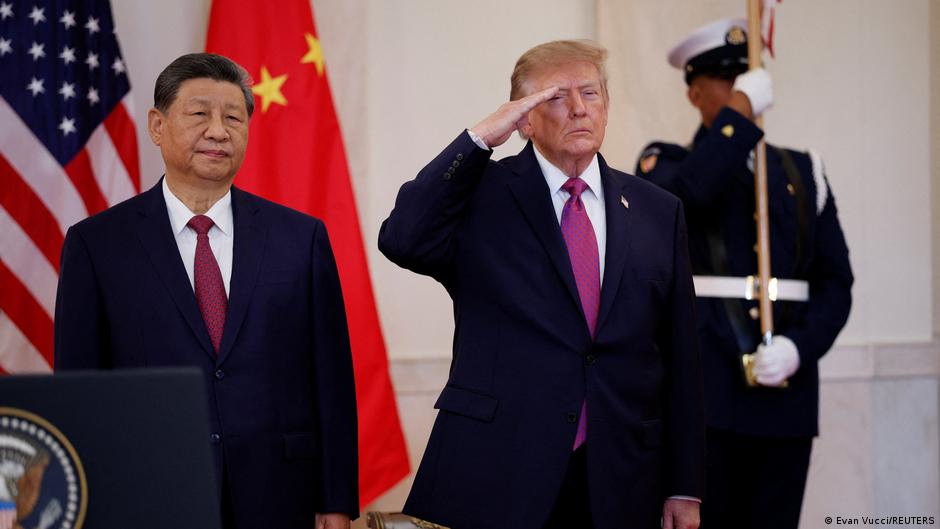
US President Donald Trump picked his Chinese counterpart Xi Jinping up directly from the airport and in his welcoming remarks he praised the strong friendship between their two nations, as well as recalling how China and the US fought together as allies during World War II. "Look at the greatness that we had together fighting in World War II," he said. "Brave American pilots volunteered to come to China and fight for the very survival of the legendary country," he said at the White House, referring to the Flying Tigers air corps that fought alongside China against the Japanese between 1941 and 1942.
However, these pilots did not actually volunteer to fight with the People's Republic of China, whose leader was visiting Washington and which was not founded until 1949. The Americans were risking their lives for the former Republic of China, whose government relocated to Taiwan after communist victory in the Chinese Civil War in 1949. "China draws on thousands of years of history and tradition from Sun Tzu to Sun Yat-sen," Trump said at a state dinner for Xi on Thursday evening.
Sun Yat-sen was the founder of the Republic of China in 1912 and the Kuomintang, or KMT, which remains a major political party in Taiwan today. Ever since the end of World War II, Taiwan has been a point of contention between Beijing and Washington. For decades, the US government ignored the communist regime in the People's Republic of China.
But since 1972, Washington has acknowledged the "one China principle," according to which there is only one China, whose legal government is in Beijing and Taiwan belongs to it. Diplomatic relations between the US and China were only established in 1979. The Taiwan Relations Act came into effect in 1979 too.
The US law legalized arms exports to Taiwan. It also allowed the US government to take military action to prevent changes to the status quo in the Taiwan Strait. A potential war between China and Taiwan would not only jeopardize stability in the Asia-Pacific region but also plunge the global economy into a prolonged recession, as supply chains would be severely disrupted.
During their high-profile meeting, Xi did not openly urge the US to respect the "one China" principle as he has done in the past, and Trump did not mention Taiwan in public either. In May, he put on hold a $14-billion arms deal that the US had concluded with the Taiwanese government late last year. The arms sales deal remains under review.
Extract — continue reading at the source.