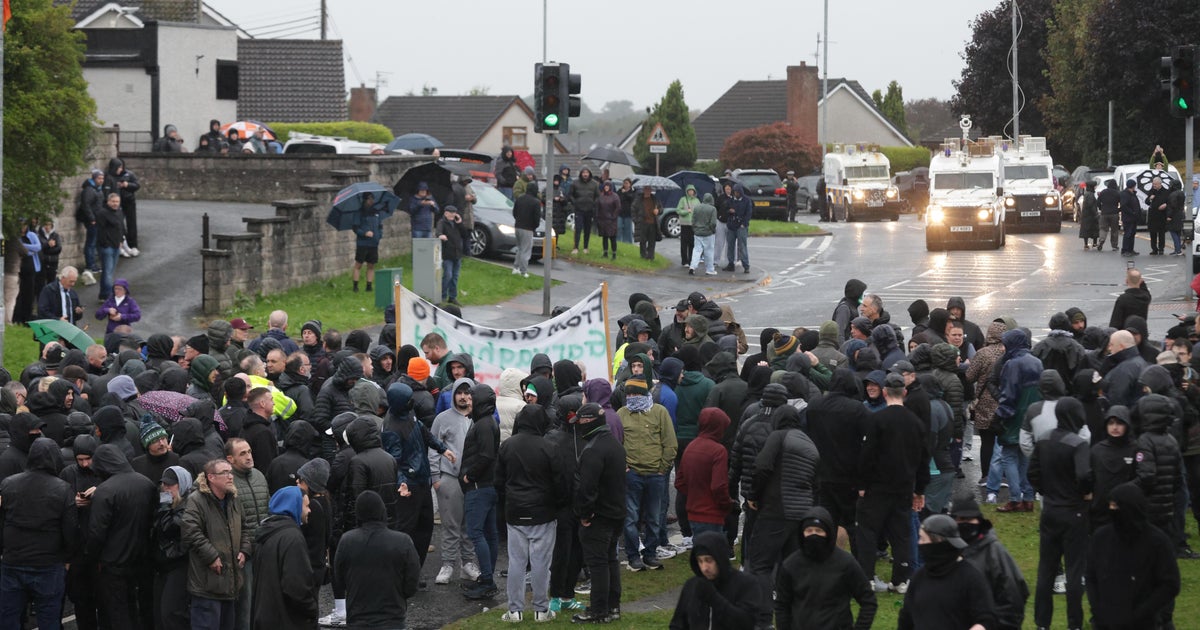
British Prime Minister Andy Burnham called for calm in Northern Ireland on Sunday after a contentious parade was given the go-ahead by the High Court in Belfast in a late-night sitting. Thousands of protesters, many wearing balaclavas, delayed the march as they blocked the Orange Order, a group hugely supportive of Northern Ireland being part of the U.K., from proceeding down a street in the town of Portadown, where many favor unification with the Republic of Ireland. "I wish we weren't in this position — I wish we weren't looking at relitigating things of the past," Northern Ireland Secretary of State Chris Bryant told BBC News.
It's the first time in nearly 30 years that the Orange Order parade has been allowed to go down the Garvaghy Road, which had been a notorious flashpoint between the communities in the years before the Good Friday Agreement of 1998 largely ended the bloodshed in Northern Ireland. During the so-called Troubles, some 3,600 people were killed while some 50,000 were wounded. Ending the Troubles meant balancing competing identities in Northern Ireland, which remained in the United Kingdom when the rest of Ireland won independence a century ago.
Irish nationalists in the north — most of them Catholic — seek union with the Republic of Ireland, while largely Protestant unionists want to stay part of the U.K. Burnham appealed for "calm on all sides" over the parade, saying there have been "big gains made in Northern Ireland, and we don't want to see things go backwards." Jon Boutcher, the head of the Police Service of Northern Ireland, called for "those with influence to encourage people to comply with the law," referring to a large protest blocking the Garvaghy Road. He said there have been no signs of violence or disorder.
"Police are engaging and working with all parties and will continue to do so. It is incumbent on us all to come together at times like this to do all we can to preserve a peaceful Northern Ireland." Politicians representing the two sides were opposed in their viewpoints on whether the march should go ahead. Northern Ireland First Minister Michelle O'Neill, who represents Sinn Féin, the party historically linked to the Irish Republican Army, said the decision to give the march the go-ahead "brings into question how this whole peace process works." "The progress of the last 28 years have been brought into question by the actions of the Orange Order and those within political unionism that want to drag us backwards," she said while attending the counterprotest on the Garvaghy Road.
Gavin Robinson, the leader of the Democratic Unionist Party, the largest pro-U.K. party in Northern Ireland, called out Sinn Féin leaders for inflaming the situation. "The rule of law cannot apply only when Sinn Féin likes the outcome," he said. "Our institutions are founded on respect for the police, the courts and the rule of law." The march was given the final go-ahead at a court hearing concluded at 2:15 a.m.
The Orange Order is named after William of Orange, a Protestant prince of Holland who defeated the Catholic King James to take over the British throne in the 17th century.
Extract — continue reading at the source.