Bafflingly entertaining and politically reprehensible, this antiwar epic follows a Chinese chef through a whirlwind of absurd and brutal events at the outbreak of the Iraq War. Not since Zhang Yimou’s 2002 wuxia spectacle “Hero” has China landed an Oscar nomination for Best International Feature — and this dry spell surely won’t be broken with this year’s bombastic submission “Once Upon a Time in the Middle East.” Like most of the country’s entries over the past decade, this blockbuster epic — a summer box office hit at home — makes for an extravagant display of the strength of the nation’s commercial film industry. Strength, in the sense that no modest operation could conceivably pull off the technical wizardry and large-scale worldbuilding showcased here, where an entire city is at one point turned into an inferno of crumbling buildings, and a massive military base is, in a later scene, ambushed in a rain of blazing pyrotechnics.
The film is also, as expected from this state-backed production, blatantly propagandistic — but in a way that is particularly baffling, and shockingly tasteless. If those sound like the elements for a good time, in the B-movie sense, then you are also correct. Against the odds, “Once Upon a Time in the Middle East” is also, both regrettably and miraculously, extremely watchable.
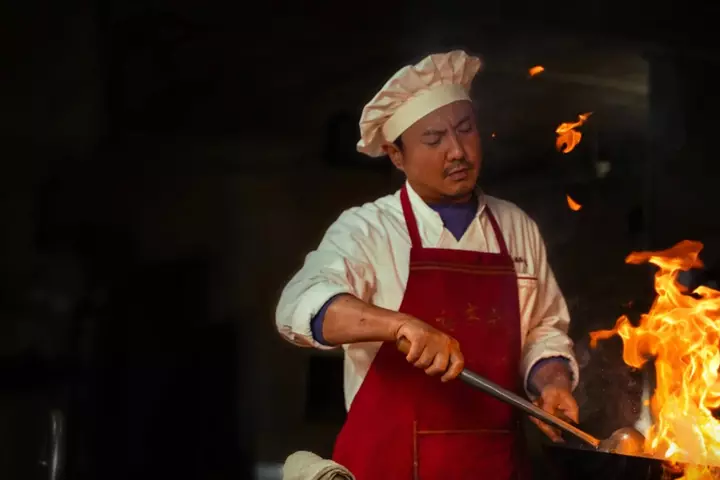
The Jekyll part of your brain will tell you to leave but the Hyde-side will keep you seated in morbid, twitchy-eyed fascination over the film’s two-and-a-half hour runtime. To cut straight to the point, this is a film in which China symbolically emerges from the rubble of the Iraq War as a pacifistic patriarch and guardian of all the world’s children. Director Wen Muyue delivers this subtext through the story of Xu Fu (Shen Teng), a debt-ridden chef who agrees to temporarily take over a Chinese restaurant in the fictional Gulf-region city of Bahata, intending to return to his daughter and mother in China in two years time.
Flash-forwards to an elder Xu Fu with liver spots and a conspicuous scar on his cheek tell us that he will indeed make it back to his family, but it’ll take much longer than a few years — the frankly absurd reasons for his delay a consequence of his, let’s say, geopolitical misfortunes. He’s a man in the wrong place at the wrong time, though, cleverly, the film makes the point that a good Chinese meal is never unwelcome. In fact it’s globally in demand — a lifeline that ensures Xu Fu’s survival through the film’s whirlwind of events.
Before we get to the grisly images of dead children covered in ash, the film starts out as a feel-good dramedy in which Xu Fu adapts to his new surroundings. Frazzled softie Ma Junsheng (Jiang Qiming), the restaurant manager, is our hero’s bridge between China and his new home, translating for Xu Fu between Arabic and Chinese during tense but diplomatic discussions with the restaurant owner Zaid (Sherif Sabby). Glossy, mouthwatering closeups of grilled meats and bubbling stone-pot stews testify to the success of Xu Fu’s kitchen takeover.
Nurturing local talent is also on the agenda when he takes on a mentee, Seif (Omar Sharif — no, not that one), an angsty orphan who learns to sublimate his rage into the art of Chinese cooking. Though as the film goes on, this anger grows into a furious, war-hardened desire for retribution. Does a delicious roasted duck stand a chance?
Extract — continue reading at the source.