Snow drought and unusually warm conditions across the Colorado Basin in 2026 sharply reduced water flowing into major reservoirs across the U.S. By summer, the effects of the weak 2025-2026 mountain snowpack in the Upper Colorado Basin had reached Lake Powell. With far less snowmelt than usual feeding the Colorado River, inflows dwindled, and the second-largest reservoir in the United States fell to record-low levels in late August and early September.
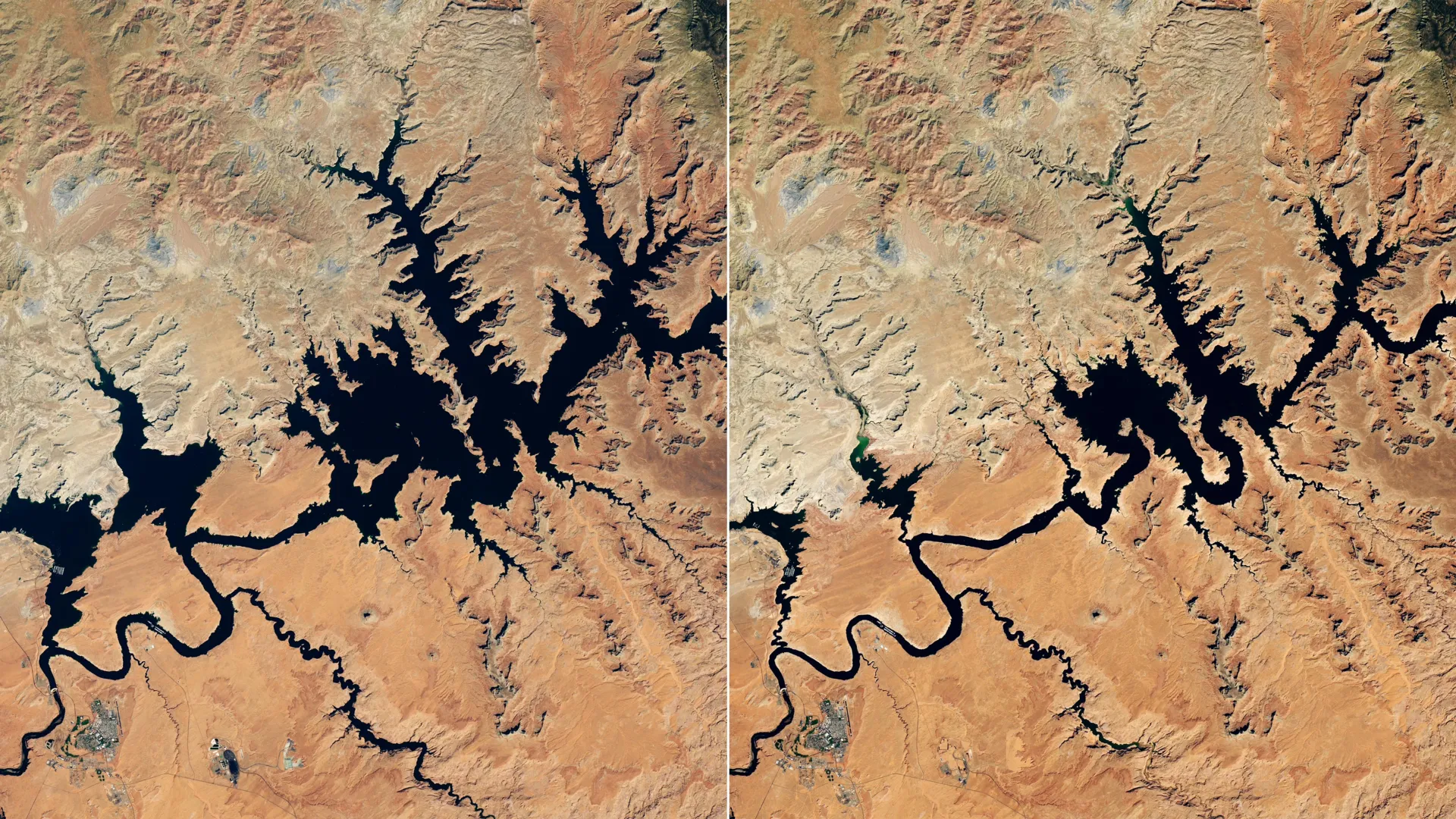
Lake Powell Falls Below Its Previous Record Satellite images captured the dramatic change in Lake Powell near Glen Canyon Dam. The images were collected by the OLI (Operational Land Imager) aboard the NASA-USGS Landsat 8 satellite on September 1, 2017 (left), and September 10, 2026 (right). In the 2026 image, Lake Powell's water surface stood at 3,517.24 feet.
Roughly a month earlier, the reservoir had already fallen below its previous record low of 3,519.92 feet, which was set on April 13, 2023. Water levels continued declining into early September. The 2017 image provides a striking contrast, showing Lake Powell during one of its highest water levels of the past decade.
The Colorado River first flows into Lake Powell before continuing downstream toward Lake Mead. In August 2026, Lake Mead also reached record-low levels. The river system, managed by the U.S.
Bureau of Reclamation (USBR) and other agencies, is a critical source of both water and electricity across the Southwest. More than 40 million people depend on it, including residents of Las Vegas, Phoenix, Los Angeles, and San Diego. The river also supplies water to roughly 5 million acres of farmland.
Why Snow Matters So Much to the Colorado River Much of the Colorado Basin is arid or semi-arid, which makes mountain snow especially important. A substantial share of the Colorado River's annual flow begins as snow that accumulates at high elevations during winter and melts during spring and early summer. The Upper Colorado Basin, along with many mountainous regions across the U.S.
Extract — continue reading at the source.