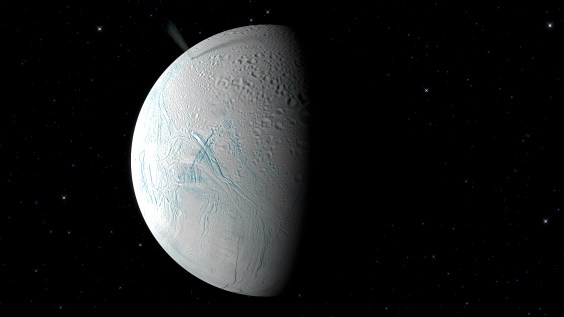
While we still don’t know if there’s extraterrestrial life out there, we do know the conditions for it exist, even in our own solar system. Enceladus, one of Saturn’s moons, is hiding vast salty oceans beneath its frigid surface. These oceans, combined with the energy and chemicals emanating from deep-sea vents, make it entirely plausible for some form of life to evolve there.
Now two studies published over the weekend are giving planetary scientists even more hope that we may find it. The first involves how we might actually discover life (assuming there’s any to discover). NASA’s Cassini spacecraft performed several flybys of Enceladus in 2005, gathering icy particulate matter spewed into space by volcanic geysers. (These minuscule grains of ice are actually what make up one of Saturn’s faintest rings.) Using long-term laboratory experiments and theoretical modeling, the team was able to determine what’s likely happening to the waters of Enceladus’ oceans as they make their way to space, and it’s quite the story.
Read more: “See Saturn Like You’ve Never Seen it Before” As bubbles filled with gas emanate from deep-sea vents, they move through the subsurface oceans and pop at the surface. These droplets are then conveyed through icy cracks into space. It was initially thought that the droplets froze almost instantly, but this new analysis suggests they freeze more slowly.
This slower process means that the dissolved components (salts, in this case, but potentially pieces of microscopic life as well) have time to separate on their way out. If the droplets collide with the icy walls on their journey to space, they get smashed into tinier fragments. The result is a variety of icy smithereens that each contain a different substance.
It could make life easier to detect. Another team of scientists recreated the conditions of Enceladus in the laboratory: low oxygen, an extremely basic pH of 10 to 11, and high concentrations of carbonate. They then introduced a species of archaea known as Methanothermococcus okinawensis.
These single-celled extremophiles thrive in deep-sea vents here on Earth, converting hydrogen gas and carbon dioxide into methane to produce energy. Remarkably, they also thrived in conditions present on Enceladus, even though the pH is much higher than in Earth’s oceans. An analysis of the genes the organisms expressed showed a shift to adapt to a lower concentration of dissolved carbon dioxide as well.
Extract — continue reading at the source.