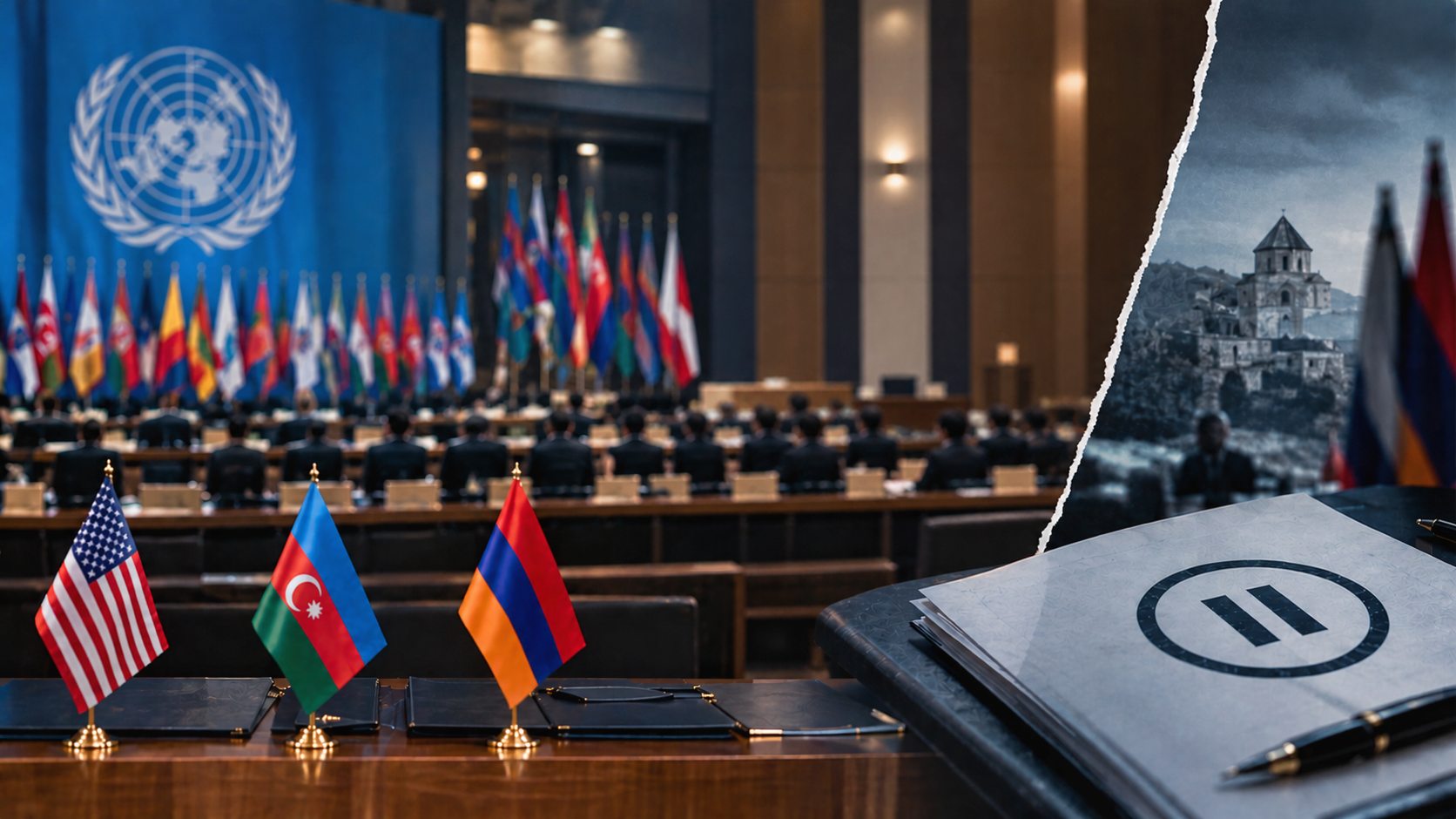
President Donald Trump spent much of his UN address deriding as useless, the General Assembly gave him an unusually receptive stage for boasting. Eight conflicts resolved since taking office, he told the chamber, several of them running for decades. Cambodia and Thailand, Kosovo and Serbia, Congo and Rwanda, Pakistan and India, Israel and Iran, Egypt and Ethiopia, and Armenia and Azerbaijan, a rivalry he noted had run for 31 years.
"I did it in just seven months," he said. "It is a great honour for me to do this." He then quoted, approvingly, Ilham Aliyev's assessment of his own diplomacy, that Donald Trump had performed a miracle in six months that nobody thought possible. It was an effective speech and a truly remarkable one for Baku.
The relations between Azerbaijan and the United States have been a story of friction instead of praise for most of the last three decades, through Section 907 of the Freedom Support Act of 1992 that banned any assistance from the US government to Baku during its occupation by Armenian troops (Joseph Biden was one of the authors of the amendment), and years of chairing the Minsk Group, which resulted in four Security Council resolutions on Armenian withdrawal but no withdrawal. Trump’s recent memo regarding the 907 waiver, added now to his UN statements, sounds in Baku like a much-needed rectification of a century-old wrong. On August 8th 2025, in Washington, President Ilham Aliyev and Armenia’s Prime Minister Nikol Pashinyan initialed a draft peace deal in the presence of Trump, along with an additional deal between the US and Armenia on the Zangezur corridor, renamed, fittingly enough, “Trump Route for International Peace and Prosperity.” Fuel products, grains, and building materials have since been transferred from Azerbaijan into Armenia; meetings of representatives of both parties on one another’s territories have become frequent, something that would have been unheard of just five years ago; last September an Armenian delegation, led by the director of the country’s National Security Service, took part in a Baku security conference.
Turkish President Recep Tayyip Erdogan also used his speech at the UN to give his blessing to the process and remark on progress in Armenian-Turkish normalisation. In terms of a war that had been going on for three decades and the displacement of a million people, six months of advancement seems plausible. Which makes the week's other headline out of Baku worth reading carefully.
Azerbaijani side have decided to postpone talks at an expert level that were meant to take place between Azerbaijan and Armenia as part of their “Bridge of Peace” project, owing to what they refer to as a growing campaign of information against Azerbaijan in Armenia. Irrespective of whether or not that is the case, it comes across as rather awkward in the context of the celebratory tone that occurred in New York. The signing of the peace treaty is now being tied to constitutional reforms within Armenia, while any comments concerning the Gandzasar monastery have been met with hostility.
There is a valid argument, put forth by Baku, behind each of these stances when considered in isolation. The constitution of Armenia, for example, does make mention of the 1990 Declaration of Independence, which makes mention of territorial claims to unification decisions made with Karabakh back in 1989, a real legal loophole, rather than a fabricated pretext. There have been times when rhetoric from elements of both the diaspora and Armenian political elites did indeed take a more revanchist tone than a reconciliatory one.
Extract — continue reading at the source.