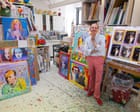
Peter Max, whose colorful, psychedelic pop art expressed the optimism of the “flower power” movement of the 1960s and graced everything from postage stamps to a cruise ship, has died at 88. Max died on Monday, his son, Adam Max, said in a written statement on Wednesday. But thanks to his prolific output and fun, accessible style, Max’s work remained well known and popular well into the 21st century.
He described his own work as “always on the side of the peaceful nature. I don’t discuss in my paintings negative things, I don’t dwell on it in my mind and don’t dwell on it in my canvasses.” Max was the official artist for the Olympics, the Super Bowl, the Indianapolis 500, the World Cup, the World Series and many other events. His art appeared on a Boeing 777 airplane and a Norwegian Cruise Line ship.
His portrait subjects ranged from US presidents to Taylor Swift. But in his first flush of success in the late 1960s and early 1970s, his mural-like tableaus of flowers, the cosmos and cartoonish figures – all in vivid colors such as turquoise, orange and neon green – seemed to be everywhere. Dorm room walls were plastered with his posters.
Household furnishings such as clocks and bedspreads sported his designs. He even created covers for the Manhattan Yellow Pages, a business phone directory distributed to millions of people. Max himself was featured on the cover of Life magazine in 1969, his trademark dark, bushy mustache framing a hearty grin.
Max was born Peter Max Finkelstein in 1937 to a Jewish family in Berlin. They fled Nazi Germany for Shanghai when he was a baby and later spent time in Tibet, Israel and Paris before settling in New York City when Max was 16. By then, he said in an interview, he was already “a huge fan of American culture”: comics, movies and “all the jazz music.” By the 1960s, Max’s bold, unique style was a hit with ad agencies, publications, the corporate world and in pop culture, leading to a booming commercial business.
One of his biggest projects after returning to public life was a series of portraits of the Statue of Liberty, painted at the White House at the invitation of first lady Nancy Reagan in 1981. Max weathered various controversies in his personal and professional life. He pleaded guilty to tax fraud in 1997 after the IRS alleged he concealed more than $1m in income from his art.
Extract — continue reading at the source.