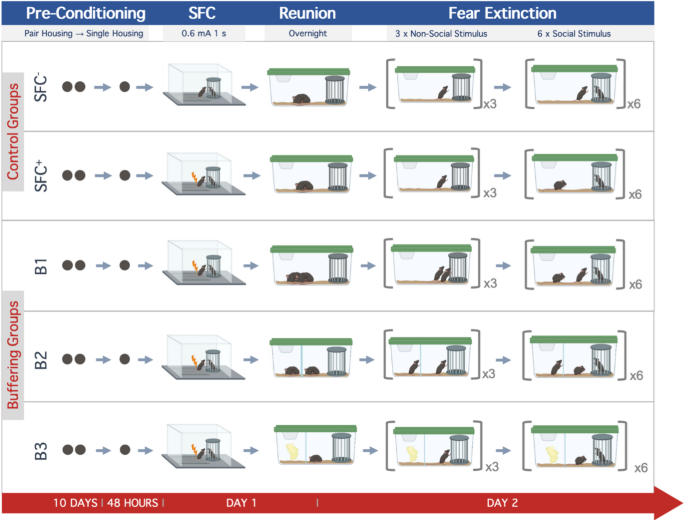
Social buffering attenuates stress and fear responses, yet the sensory requirements for effectively buffering social fear remain unclear. Here, we established a paradigm combining social fear conditioning with social buffering to determine whether buffering efficacy depends on tactile, visual, and/or olfactory contact with a familiar conspecific. Adult female and male mice underwent social fear conditioning and were then housed for 24 h under one of three buffering conditions: full multisensory contact, visual and olfactory access, or olfactory access alone.
Social fear was assessed thereafter, and mice without buffering served as controls. Conditioned mice without buffering showed impaired social preference and robust social fear, with a trend toward stronger fear expression in females. Only mice receiving full multisensory buffering retained normal social preference and showed no social fear in both sexes, with a more pronounced effect in females, whereas restricted sensory conditions were ineffective.
Notably, only conditioned females without buffering showed extinction, while the lowest freezing levels were found in females exposed to full multisensory buffering. Together, these findings demonstrate that effective buffering requires full multisensory contact with a familiar conspecific and establish this paradigm as a framework for dissecting modality- and sex-dependent mechanisms of social buffering of social fear. Open Access funding enabled and organized by Projekt DEAL.
This work was funded by the German Research Foundation (DFG) through the Research Training Group RTG 2660 (Grant no.: 433490190; Project C3 to EA and ASB). The APC was funded by the Open Access Publication Fund of the University of Wuerzburg. The funders have no role in study design, data collection and analysis, decision to publish or preparation of the manuscript.
These authors jointly supervised this work: Iulia Zoicas and Angelika Schmitt-Böhrer. Department of Psychiatry, Psychosomatics and Psychotherapy, Center of Mental Health, University of Wuerzburg, Wuerzburg, Germany Elif Salur, Xianhui Li & Angelika Schmitt-Böhrer Institute of Anatomy and Cell Biology, University of Wuerzburg, Wuerzburg, Germany Department of Psychiatry and Psychotherapy, Friedrich-Alexander University Erlangen-Nürnberg (FAU), Erlangen, Germany Correspondence to Angelika Schmitt-Böhrer. The authors declare no competing interests.
Springer Nature remains neutral with regard to jurisdictional claims in published maps and institutional affiliations. Open Access This article is licensed under a Creative Commons Attribution 4.0 International License, which permits use, sharing, adaptation, distribution and reproduction in any medium or format, as long as you give appropriate credit to the original author(s) and the source, provide a link to the Creative Commons licence, and indicate if changes were made. The images or other third party material in this article are included in the article’s Creative Commons licence, unless indicated otherwise in a credit line to the material.
Extract — continue reading at the source.