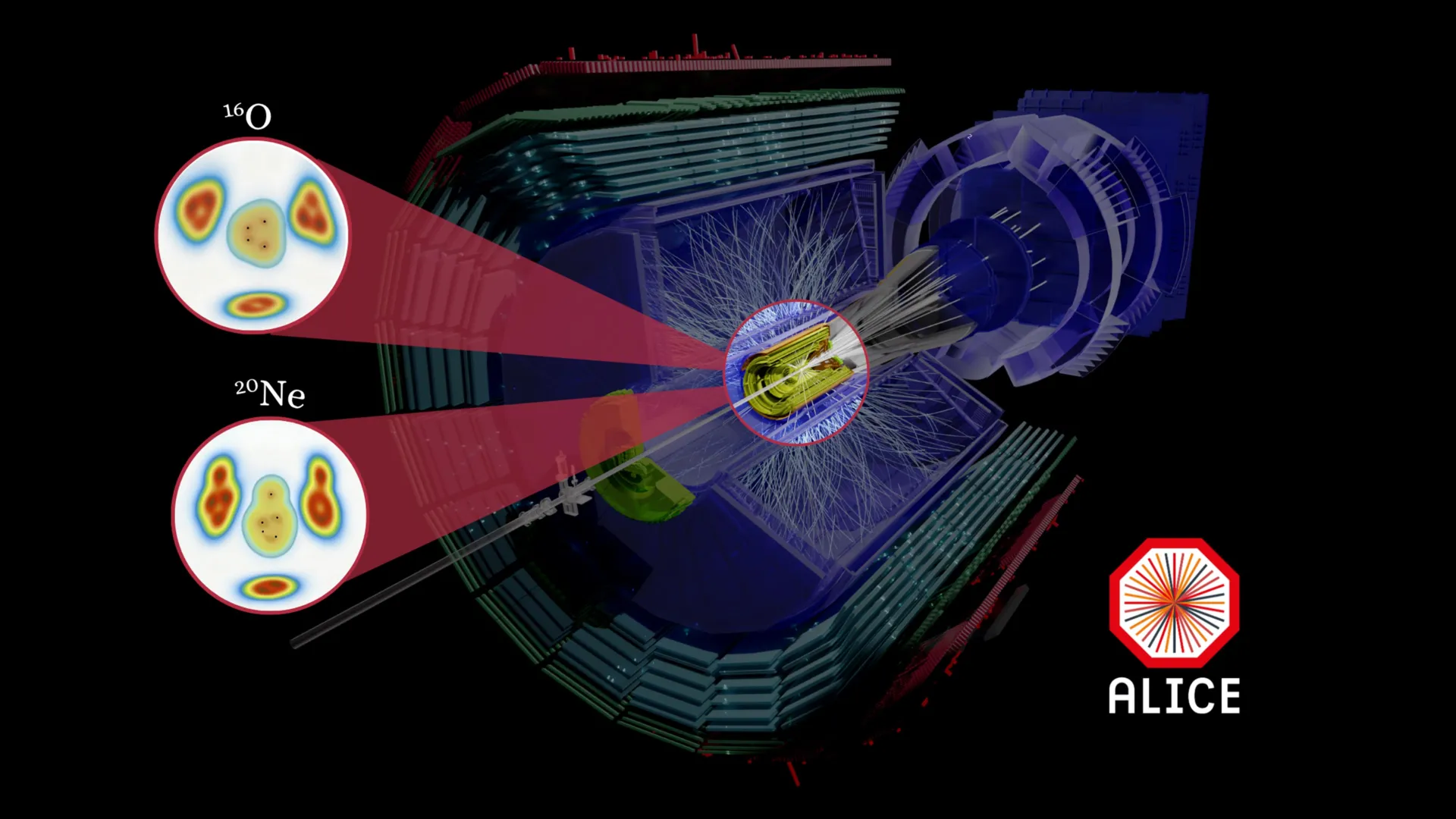
Researchers at the University of Copenhagen have recreated the primordial state of matter believed to have filled the Universe shortly after the Big Bang, using collisions between atomic nuclei far smaller than scientists once thought possible. These microscopic versions of the early Universe could help researchers understand both the first moments of cosmic history and some of the deepest questions in nuclear physics. What was the Universe like before stars, planets, atoms, and the other familiar forms of matter existed?
At CERN in Switzerland, physicists are trying to answer that question by reproducing some of the extreme conditions that existed in the Universe shortly after its birth. Researchers from the Niels Bohr Institute, working with scientists in the international ALICE collaboration, have now taken an important step toward that goal. Recreating the Universe's Primordial Matter At CERN, atomic nuclei can be accelerated to nearly the speed of light and smashed together.
These collisions can create tiny droplets of quark-gluon plasma, the extraordinary state of matter believed to have filled the Universe during its first millionth of a second. Scientists had long thought that producing this plasma required collisions between very heavy nuclei, such as lead. The new experiments show that much smaller nuclei can also generate the primordial material.
Researchers successfully created it by colliding oxygen-16 and neon-20 nuclei. "We have pushed the boundary for how small the atomic nuclei can be while still recreating this primordial matter - what you could call a Little Big Bang. We now know more about the fundamental conditions required for matter to transition into this extreme state," says Associate Professor You Zhou, who led the experiment and until recently was employed at the Niels Bohr Institute at the University of Copenhagen.
"Hopefully, this will help us better understand how the plasma behaved during the first moments of the Universe - and how it later evolved into the forms of matter that everything around us is made of." The research findings, produced as part of the international ALICE experiment, have just been published in the prestigious journal Physical Review Letters. A Tiny Big Bang With a Bowling Pin Signature When atomic nuclei collide at enormous speeds, their constituents can transform into an extremely small droplet of quark-gluon plasma. The droplet survives for only a tiny fraction of a second before expanding and converting into other particles.
Scientists cannot observe the plasma itself directly. Instead, they measure the particles that emerge immediately afterward and study how those particles move. The new results show that these movement patterns preserve information about the original shape of the colliding nuclei.
Extract — continue reading at the source.