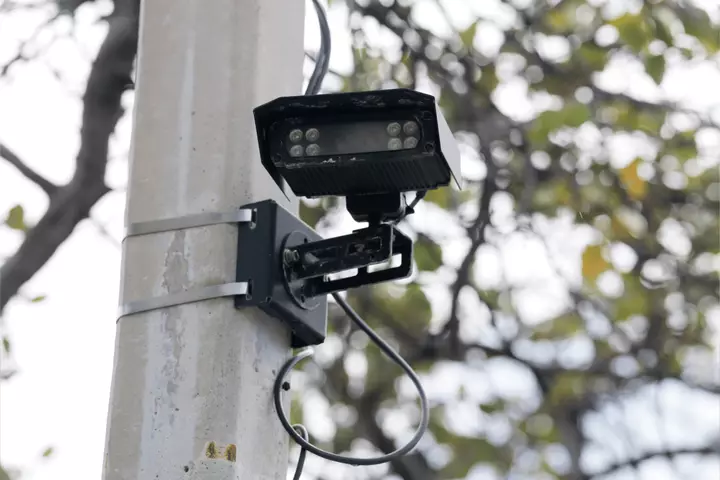
Police are increasingly able to use AI to analyze Americans' driving patterns and flag motorists as potentially suspicious even when they were not previously suspected of a crime, according to a new report from the American Civil Liberties Union (ACLU). The ACLU's October 26 report raises concerns about the combination of AI and automated license plate readers, or ALPRs, which photograph vehicles and record information that can include their license plates, locations, and identifying characteristics. The organization argues that the technology represents a shift from using license-plate records to investigate known suspects toward using people's movements to generate suspicion in the first place.
The ACLU points specifically to technology offered by Flock Safety, a major ALPR provider. ALPR technology isn’t new and has legitimate law-enforcement applications, including identifying stolen vehicles and developing investigative leads. Department of Justice report on AI and criminal justice specifically described automated license plate recognition as "an increasingly common practice for identifying vehicles that may be involved in criminal activity." However, the ACLU says the technology’s newer, more advanced capabilities can go further than simply identifying vehicles that are already linked to suspected criminal activity.
It can now use AI to analyze huge amounts of location data to identify and flag travel patterns it thinks are suspicious. Newsweek has contacted ACLU and Flock Safety for comment. The ACLU highlighted the experience of Grace Knowles, a woman from northern Virginia who took a road trip across several states in 2025.
Knowles told the organization that while traveling from Louisiana toward Florida, she was stopped by an officer who initially said she had spent too long in the left lane. But she said the officer later told her that a scan of her license plate had revealed what he described as "suspicious travel patterns." According to Knowles' account, the officer showed her software mapping out the locations where her vehicle had been recorded, including photographs of her license plate. Among capabilities previously advertised by Flock Safety is "Multi-State Insights," designed to alert law enforcement when suspect vehicles are detected across multiple states.
Flock has said the feature is intended to help uncover patterns associated with crimes including human and narcotics trafficking and organized retail crime. Other capabilities can identify vehicles repeatedly seen together or vehicles appearing at multiple locations. The concern, according to the ACLU, is that such analysis could effectively turn ordinary travel into grounds for further scrutiny.
The organization says around 120,000 Flock cameras are installed in urban and rural areas and claims that less than 1 percent of vehicles scanned by ALPRs are associated with crime or any wrongdoing. For motorists, the development means a vehicle's movements could potentially become part of a searchable digital record even if its driver hasn’t committed a crime. Flock states that its cameras capture license plates and vehicle characteristics to produce searchable evidence that can help investigators determine where vehicles appeared and connect them with incidents.
Extract — continue reading at the source.