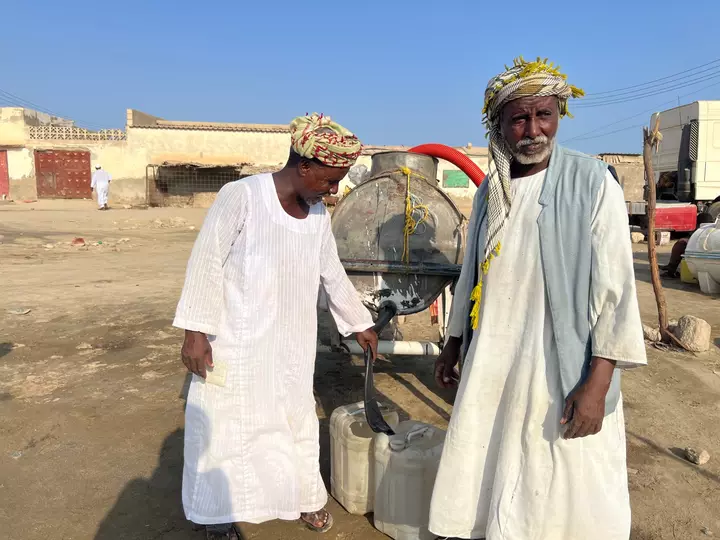
Port Sudan, Sudan – Every day, Amina Khalafallah spends 10,000 Sudanese pounds ($1 at the parallel market rate) on water for herself and her four children. Over a 30-day month, that amounts to 300,000 pounds ($30) – the equivalent of her entire monthly salary. Khalafallah lives in the Deim Mayo neighbourhood of Port Sudan, in eastern Sudan, where her home is not connected to a piped water network.
Instead, she depends on street vendors, who charge 1,000 pounds ($0.10) for 18 litres. Khalafallah works in a cafeteria at a private institution, while her husband works in another state and sends money to help her out when he can. Between them, the family barely scrambles enough money to get by, but Khalafallah says she often has to borrow money.
It’s a typical story in Sudan, where, according to the United Nations Development Programme (UNDP), the country’s more than three-year-long war has pushed average incomes back to levels last seen in the early 1990s. The hotter months bring additional challenges, as water prices rise and vendors become harder to find. According to the African Development Bank (AfDB), access to safe water is one of Sudan’s most urgent needs, with millions of children at risk of waterborne diseases.
In Port Sudan, relatively safe from the fighting that has plagued other areas of the country, the arrival of people displaced by the war has put additional pressure on already fragile infrastructure. The AfDB has reported that the city’s water supply was meeting less than 40 percent of demand. One of the major issues Port Sudan has faced is the collapse of the Arbaat Dam.
Located in the Red Sea Hills northwest of Port Sudan, it once supplied half of the coastal city’s daily water needs. But in August 2024, heavy rainfall and flooding caused the dam to collapse, destroying villages downstream and damaging pipelines and wells. As a result of the collapse, entire neighbourhoods are dependent on expensive water deliveries by truck.
Ahmed Osman, 30, has spent the past three years working at a water distribution station that supplies street vendors who deliver water to households. When Sudan’s war began in April 2023, Osman said he charged vendors 4,000 Sudanese pounds ($0.40) to fill a donkey-drawn cart carrying at least 250 litres of water. Those prices have since risen sharply, he said, because of increasing operating costs, particularly the fuel needed to transport water to his distribution station.
Extract — continue reading at the source.