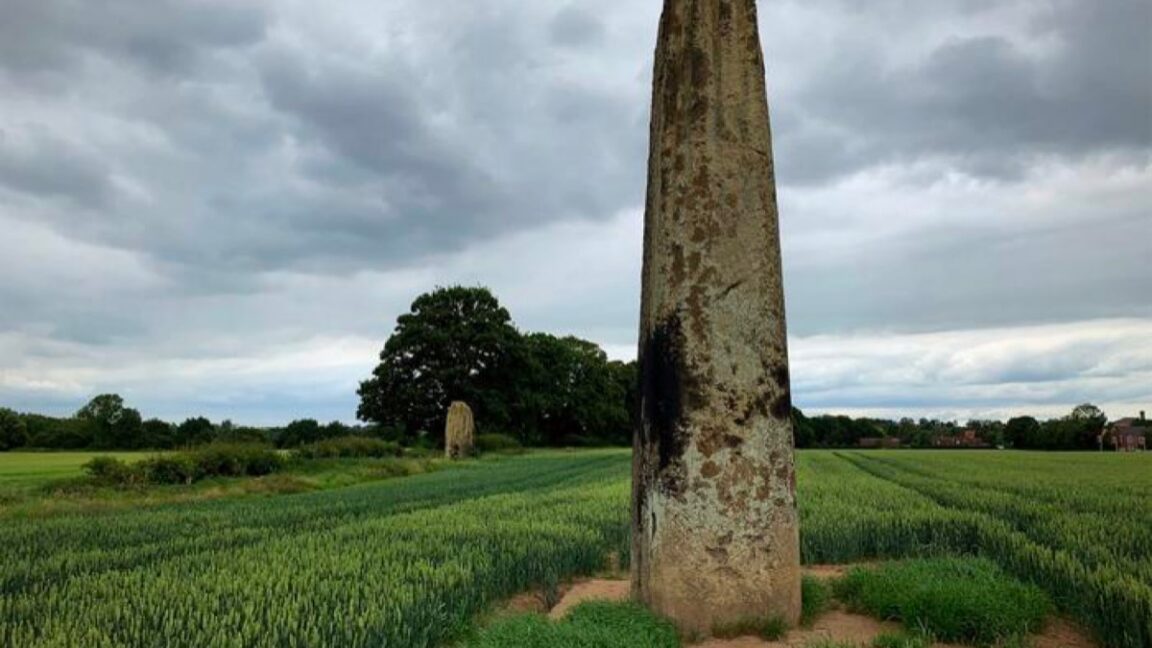
Stonehenge is the most famous example of megalithic architecture across Britain and Ireland, but there are plenty of others, including Calanais, Newgrange, and Avebury, as well as the Devil’s Arrows. The latter is Britain’s tallest standing stone alignment, yet little is known about the provenance of its stones. Scientists have confirmed that the stones came from a site 18 kilometers (11 miles) away, transported by humans rather than glacial movement, according to a paper published in the Proceedings of the Royal Society A: Mathematical, Physical and Engineering Sciences.
For instance, a 2019 study concluded that the 42 bluestones that make up the inner ring came all the way from western Wales. The outer layer of sarsen stones hails from much closer to home: Marlborough Downs, an area of round, grassy hills 25 to 30 km (17 miles) north of Stonehenge, which has the largest concentration of sarsen in the UK. In 2024, Anthony Clarke, who co-authored this latest study, and his team discovered that the Stonehenge Altar Stone originated from the Orkney region in the very northeast corner of Scotland, rather than Wales.
Next, they tackled the long-standing debate over how the stones got to that location in the first place. One theory holds that glaciers moved the bluestones at least part of the way from Wales to Salisbury Plain in southern England, while others contend that humans moved them—although precisely how that was done has yet to be conclusively determined.
Extract — continue reading at the source.