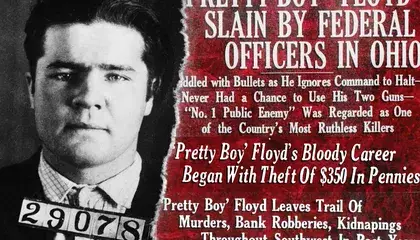
The late afternoon sun baked the Ohio cornfield in a wash of orange and red—an earthly premonition of the bloodshed soon to come. A volley of gunshots cut through the usual autumn quiet as a man in a mud-stained blue suit dashed through the tree line, a group of officers on his tail. As the officers approached the man, he looked up at them in shock.
Thirty-year-old Charles Arthur “Pretty Boy” Floyd, America’s public enemy No. 1, was dead at the hands of the Federal Bureau of Investigation. Nearly a century later, Floyd still captivates the American psyche. One of the most high-profile criminals of the Great Depression—often making headlines alongside the infamous Bonnie Parker and Clyde Barrow, John Dillinger, and George “Machine Gun” Kelly—Floyd is emblematic of his time.
A poor American farmer-turned-bootlegger who embraced a life of crime, Floyd danced on the line of lawlessness until he crossed the point of no return. But he also earned a reputation as a champion of the poor, stealing from the banks that many of his fellow rural farmers viewed as the real thieves. Ultimately, Floyd’s legacy is neither as robber nor Robin Hood, but rather as a complex character whose story reflects a series of upheavals in law enforcement, media and the United States economy.
Floyd was born into a farming family in Georgia in 1904, the fourth of eight children. When he was still young, his family moved to rural Oklahoma. They settled along the southern edge of the Cookson Hills, a rugged and poorly maintained stretch of land that would soon develop a reputation for housing outlaws.
Floyd grew up on meager farm fare—but his other sources of sustenance were stories of the legendary Belle Starr and Jesse James, violent criminals who fancied themselves heroes of the common man. At the time, Oklahoma was undergoing major changes. White families like the Floyds flocked to what was previously tribal-controlled land, often encroaching on either sovereign Indigenous states or communities of formerly enslaved African Americans and their descendants.
These new white settlers had little more to their names than those they displaced. In 1919, the state’s per capita income peaked at 83 percent of the national average before falling to 67 percent in 1921. Populist sentiment bubbled against this backdrop of economic hardship.
Extract — continue reading at the source.