There are, by various estimates, several trillion planets within the local group of galaxies including our own Milky Way. Many of these are within the habitable zone of their stars. So if life finds a way, where are the alien civilizations?
This is the crux of what is known as the Fermi paradox, which posits that if life is fairly common in the Universe, humans should have collected credible evidence for the existence of extraterrestrial civilizations by now. People who think about this paradox believe there may be some “filter” which limits or entirely prevents an advanced civilization from sending out probes or even life-bearing spacecraft to nearby stars. Philip Johnston is someone who thinks a lot about the Fermi paradox.
A mathematician and physicist from the United Kingdom, Johnston has gained some notoriety lately in the space community as one of the biggest proponents of orbital data centers. He co-founded Starcloud in 2024 to develop such data centers, and the company is presently valued at $2.3 billion. Johnston is in the midst of scaling up Starcloud, working through technical issues, and raising hundreds of millions of dollars.
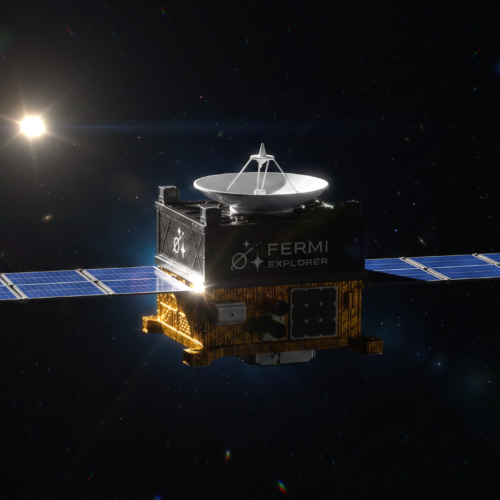
But Johnston also wants to send a mission to the nearest star to our Sun and investigate the Fermi paradox. On Tuesday, Johnston and a handful of other entrepreneurs announced the “Fermi Explorer” mission. In concept, it is simple.
They seek to raise $15 million to build a small spacecraft, carrying a 1-kg payload, and launch it to Alpha Centauri such that it reaches that system in less than 80,000 years. In conversations about the Fermi paradox, Johnston realized such a mission would knock two “filters” off the list: Species won’t want to send spacecraft beyond their home star, or species will find that interstellar transit is too difficult.
Extract — continue reading at the source.