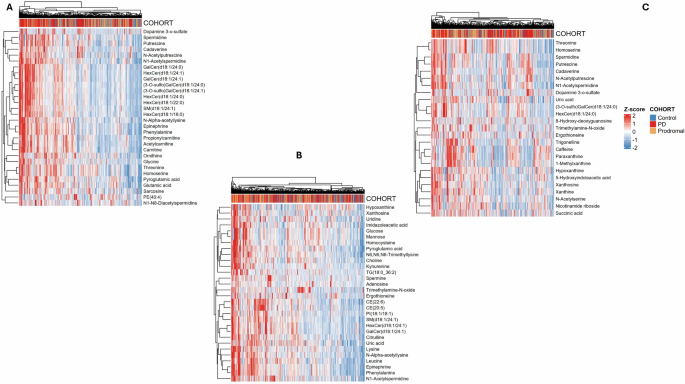
Parkinson’s disease (PD) is a progressive neurodegenerative disorder with a prolonged prodromal phase and complex motor symptoms. Despite improved clinical criteria, early diagnosis and longitudinal monitoring remain challenging. While cerebrospinal fluid (CSF) and plasma metabolites and proteins show biomarker potential, their utility in predictive models is insufficiently characterized.
We employed a secondary computational approach to integrate proteometabolomic profiles from CSF and plasma samples of >1100 Parkinson’s Progression Markers Initiative (PPMI) participants. Using multi-omics machine learning, we identified biofluid-specific signatures and evaluated predictive performance. Twenty-one biomarker candidates were validated across three models (SVM, GLMNET, RF); SVM and GLMNET achieved the highest recall (83–86%) and AUCs of 0.84–0.89.
Longitudinal mixed-effects modeling revealed eight candidates associated with progression across diagnostic stages. We identified a three-part molecular framework characterizing neurodegeneration: a diagnostic subpanel reflecting early microbiome dysregulation (secretory granins and metabolites) and synaptic breakdown; a second subpanel monitoring phenoconversion via neurogenesis precursors and extracellular matrix proteins; and a third subpanel tracking progression through chronic neuroinflammation and immune activation. This integrated multi-omics approach provides a robust framework for stage-specific PD monitoring and potential clinical deployment.
Cerebrospinal fluid (CSF) provides a direct window into the central nervous system pathology due to its close interaction with brain tissue and its enrichment in proteins, metabolites5, and other molecular indicators reflective of neurodegeneration6. Integrating multiple biofluids, such as CSF and plasma, offers a more comprehensive view of disease biology, as each captures complementary aspects of pathological processes. In this context, the identification of robust biomarkers is particularly critical for PD, where reliable indicators are needed to distinguish disease stages, improving disease progression monitoring, supporting early diagnosis, and therapeutic development.
Despite advances in neuroimaging, molecular profiling, and computational methods, the translation of these insights into clinically useful biomarkers remains limited7,8. Early diagnosis and longitudinal tracking are still constrained by the lack of sensitive, specific, and accessible markers, a challenge compounded by the marked heterogeneity of PD and its overlap with other neurodegenerative disorders2. Traditional biomarker discovery has largely focused on single molecular targets, like dopaminergic metabolites in plasma or α-synuclein levels in CSF9,10.
While informative, these approaches rarely achieve the sensitivity and specificity required for reliable disease stratification or progression tracking. Interpatient variability and disease-stage differences further limit their clinical utility, underscoring the need for strategies that capture the multi-dimensional nature of PD biology. Emerging evidence supports the use of integrative, multi-omics strategies that combine data across biofluids and molecular layers6.
Extract — continue reading at the source.


