The largest desert on Earth is feeding the largest forest on Earth
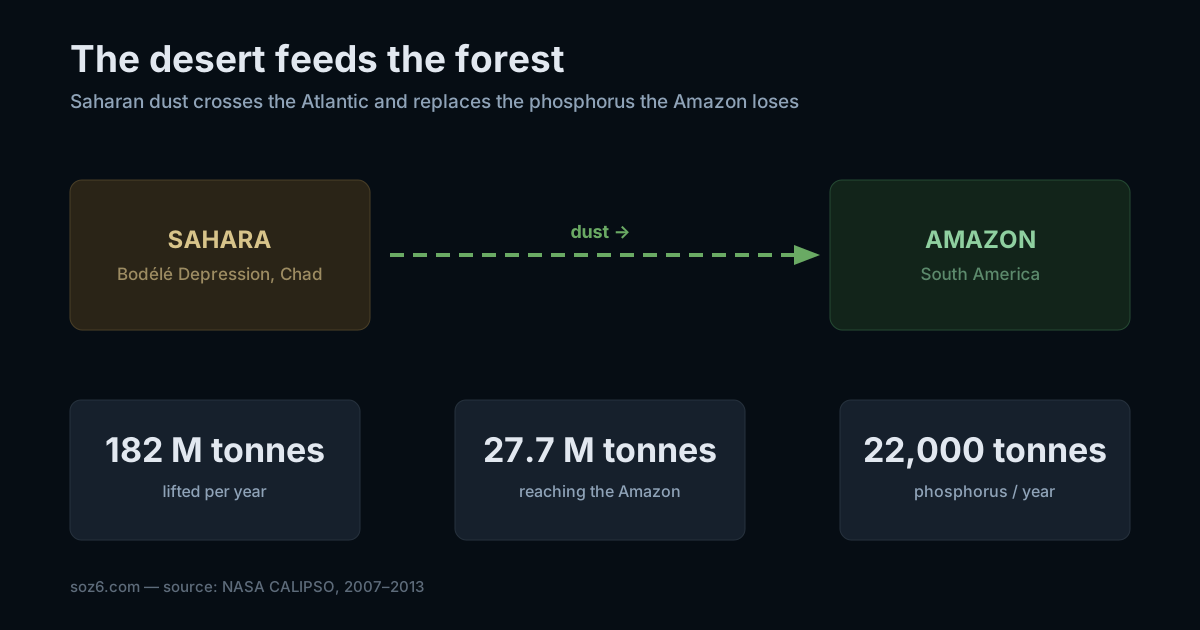
Every year 27.7 million tonnes of Saharan dust cross the Atlantic and fall on the Amazon. The phosphorus in it almost exactly replaces what the rainforest loses to rain. The dust comes from the floor of a dried lake in Chad — and six thousand years ago the Sahara itself was green.
It is hard to find two landscapes further apart. The Sahara is the largest hot desert on the planet. The Amazon is the largest rainforest on it. One goes years without rain; the other is rained on twice a day. An entire ocean lies between them. And yet, without one, the other could not stay as it is.
Every year the wind lifts roughly 182 million tonnes of dust off the western edge of the Sahara and carries it out over the Atlantic. Of that, 27.7 million tonnes make the full crossing and settle over the Amazon basin. These are not guesses: NASA's CALIPSO satellite spent 2007 to 2013 firing lasers into the atmosphere, slicing the dust plumes into layers and measuring their height and density.
But the weight of the dust is not the point. What is in it is.
The most common misconception about a rainforest is that the soil beneath it must be rich. It is the opposite. Amazon soil is poor. The forest's wealth is not in the ground but in the trees themselves — in leaf, trunk and root. When a leaf falls, its nutrients are pulled back almost immediately, and whatever reaches the soil is washed away. The rain that keeps the forest alive is the same rain that keeps it poor.
The nutrient that leaves fastest is phosphorus. Plants cannot build proteins, move energy or grow without it. And in the Amazon, phosphorus drains steadily into the rivers and out to sea.
Saharan dust delivers about 22,000 tonnes of phosphorus a year. That is very close to the amount the forest loses to rain and runoff. The desert, in other words, balances the forest's books.
And where the dust is born is the best part of the story. Most of it does not rise from the Sahara at large but from a single place: the Bodélé Depression in Chad. It is the dustiest spot on Earth.
Bodélé was once underwater. It is the floor of a vast lake called Mega-Chad, one of the largest lakes that has ever existed. When the lake dried, it left behind what had accumulated on its bed over millennia: diatoms — the glassy skeletons of microscopic algae. They are loaded with phosphorus.
So the chain closes. A dead lake dries into dust; the wind lifts it; the dust crosses an ocean; and algae that died in Africa are growing trees in South America today.
You could stop there, except one question remains: has the Sahara always been desert?
No. As recently as six thousand years ago — not far, in time, from the building of the Egyptian pyramids — much of the Sahara was green. There were lakes, grassland, hippopotamus. We are not inferring this: the people who lived there painted their lives on the rock. On the Gilf Kebir plateau, near the Libyan–Egyptian border, there is a cave whose wall shows human figures swimming. There is now no water for a thousand kilometres.
What dried the Sahara was not a climate catastrophe. It was the wobble of the Earth's own axis. The wobble completes a cycle roughly every 20,000 years, and it changes how far north the African monsoon reaches. When the monsoon pushes north, the desert greens; when it retreats, the desert returns. The Sahara is not a fixed place. It is a very slow heartbeat.
Which means the Sahara will be green again. And on that day the dust will stop.
How the Amazon would absorb that loss is still argued over; scientists raise the question, and the answer is not settled. But the idea is strong enough on its own: nothing on Earth stands alone. A place that looks empty on the map — a yellow blank where nothing grows and nobody lives — turns out to be the supply line for the densest life on another continent.
A desert is not waste ground. It is somebody's warehouse.