The world is about to stop correcting time — just as Earth starts speeding up
In 2022, governments agreed to stop adding leap seconds by 2035. In those same years the planet unexpectedly sped up. The result may be something never done before: taking a second away.
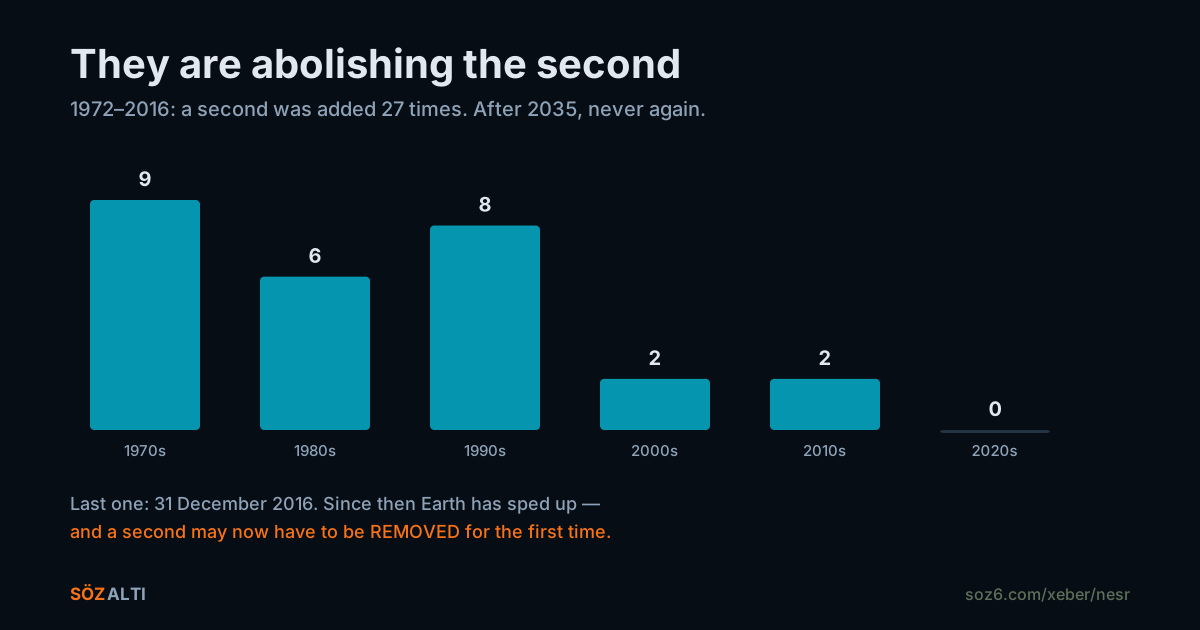
Human time and Earth time are not the same thing. Atomic clocks measure the second at a fixed rate; the planet's spin is variable — the Moon slows it, while oceans, atmosphere and motion in the core can slow or speed it. To stop the two drifting apart, a second has been added to UTC from time to time since 1972.
It has happened 27 times. The last was on the final night of 2016, when one minute lasted 61 seconds.
For software this is not a trifle. Leap seconds have caused real outages over the years: servers stalling, airline systems freezing, data centres unable to handle a clock stepping backwards. Computers expect time to move forward; when a second repeats, things break.
In November 2022, at the General Conference on Weights and Measures in Versailles, governments voted to end the practice by 2035. Russia voted against — its GLONASS satellite system is built around those corrections. The resolution passed anyway.
The logic is to allow the gap between Earth time and atomic time to grow beyond a single second. The gap widens so slowly that the next correction might not be needed for centuries, arriving as a 'leap hour'. The problem is not solved so much as handed forward.
This is where it becomes interesting.
Since 2020, Earth has been unexpectedly speeding up. The shortest day since atomic measurement began was 5 July 2024 — 1.66 milliseconds shorter than average. The causes are not fully settled: motion in the core, mass shifting across the surface, the atmosphere.
If the trend holds, the consequence inverts. Until now seconds have only ever been added, because the planet was slowing. Now, for the first time, one may have to be removed — a 'negative leap second'. It has never been done. The geophysicist Duncan Agnew puts the probability at roughly 40% before 2035, with 2029 the likeliest date.
For programmers this is not good news. The ordinary leap second has existed for decades and still breaks systems. A negative one has never been tested: almost no code in the world anticipates a minute containing 59 seconds.
The result is a fine irony. Humanity grew tired of tracking the planet's irregularity and decided to cut time loose from Earth. At that exact moment, Earth became more irregular.
After 2035 our clocks will answer to the vibration of atoms alone, not to the turning of the planet. The gap will widen quietly — seconds first, then minutes. Someday, far ahead, somebody will have to fix it.
It simply will not be us. That, in the end, is what the decision actually decided.