Why New York got 212: the city ranking hidden inside phone numbers
In 1947 America handed out telephone area codes, and it did not do so at random. The fewer clicks a code took on a rotary dial, the bigger the city. The result was a hidden ranking of American cities, encoded in phone numbers.
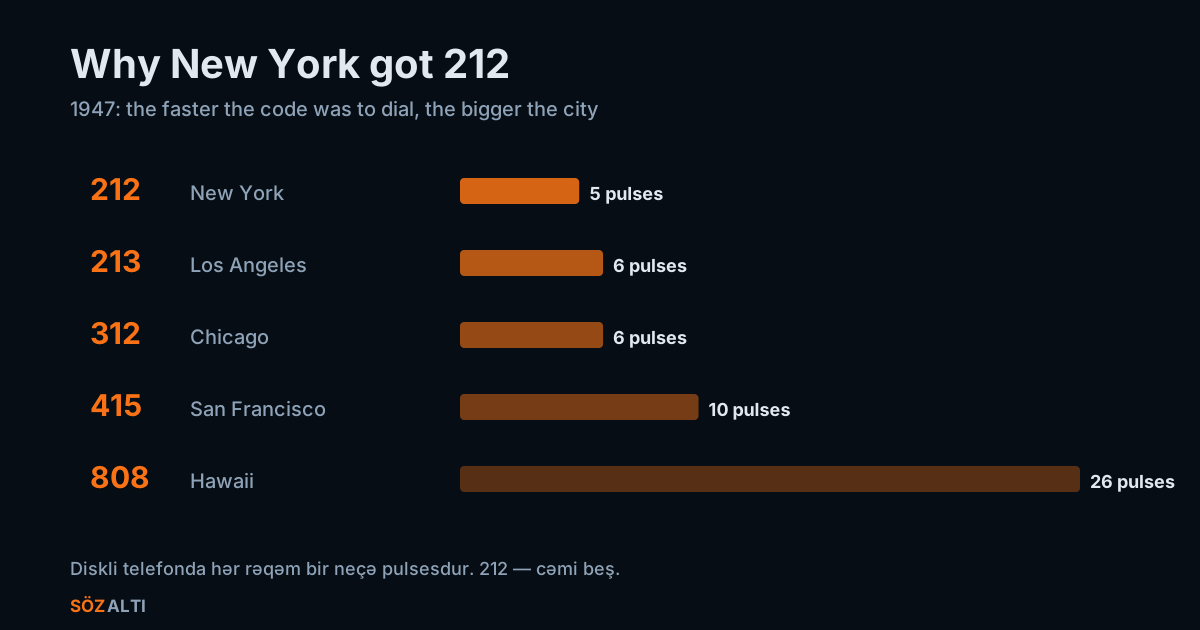
Anyone who remembers a rotary telephone knows the digits did not take equal time. The dial travelled a short way for 1 and a long way for 9, because each digit sent that many electrical pulses. One is one pulse. Nine is nine. Zero is the worst: ten.
When AT&T and the Bell System drew up the North American Numbering Plan in 1947, that detail became a design problem. Engineers knew that in the busiest cities the delay would repeat thousands of times an hour.
So the rule became: the codes needing the fewest pulses go to the cities making the most calls.
Within the constraints of the switching equipment, the fastest possible code was 212 — five pulses in total. It went to New York, the densest telephone centre in North America.
The rest reads like a ranking. Los Angeles took 213 and Chicago 312, six pulses each. San Francisco got 415: ten pulses. Hawaii got 808 — twenty-six, close to the slowest code available.
In 1947, then, an American saying their area code was also stating their city's standing. Nobody announced this. It was simply engineering logic, made visible.
The interesting part is that the technology vanished and the codes stayed. Rotary dials were obsolete by the 1980s; tone dialling erased any difference between digits. Today there is no time difference whatsoever between dialling 212 and 808.
Yet 212 is still valuable — for a different reason now. In Manhattan a number beginning 212 signals age and status, and there are brokers who trade them. What began as an engineering decision became a geographic marker, then a status symbol.
This happens constantly in technology. The shape of a thing outlives the reason for its shape. QWERTY was arranged for mechanical typewriters; the typewriters went, the layout stayed. Railway gauges, book sizes, area codes — all fossils of constraints that no longer exist.
When somebody in New York pays extra for a 212 number today, what they are really paying for is an engineer's decision, in 1947, about how far a finger had to travel around a dial.