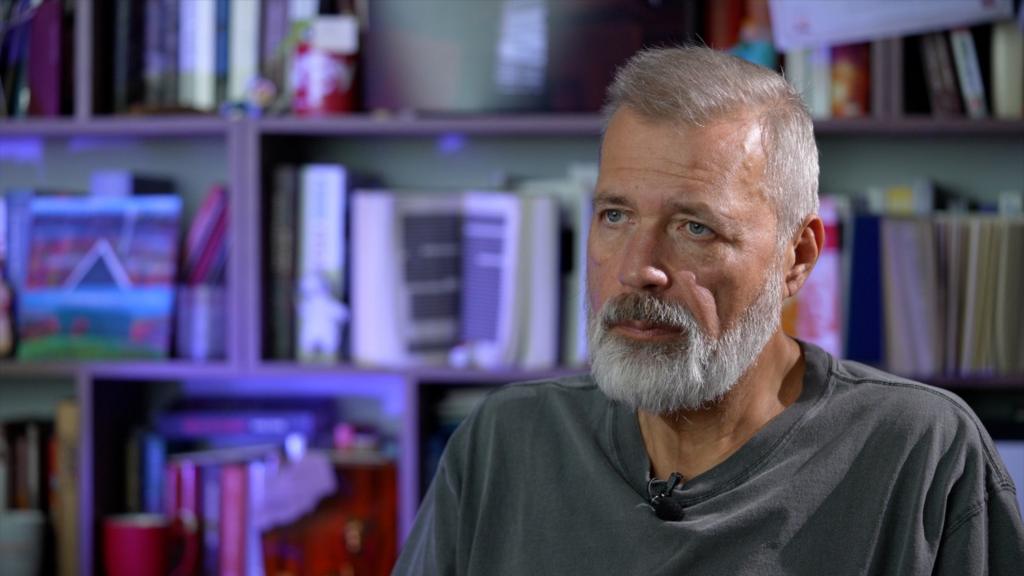
At the Moscow offices of newspaper Novaya Gazeta, the corridors are silent. There is an overwhelming sense of emptiness. "There is no newspaper anymore," former chief editor Dmitry Muratov tells me in an exclusive interview, published on the BBC News YouTube channel, external.
Muratov, 64, co-founded Novaya Gazeta more than 30 years ago. It became the flagship for hard-hitting independent journalism in Russia, shining a light on human rights abuses and high-level corruption. In 2021 Muratov was joint winner of the Nobel Peace Prize for his efforts "to safeguard freedom of expression." The Nobel Committee noted that "six of [Novaya Gazeta's] journalists have been killed, including Anna Politkovskaya who wrote revealing articles on the war in Chechnya." It was recognition for courageous reporting.
"Putin issued a decree and the newspaper's printing presses were nationalised," Muratov explains. "Its registration was revoked." Novaya Gazeta does retain a presence online. But only just: the authorities have blocked access to its website.
It can only be accessed from abroad, or with the help of VPNs – virtual private networks used to circumvent restrictions. The newspaper's difficulties reflect the broader crackdown on free speech in Russia which has accelerated since the Kremlin's full-scale invasion of Ukraine in 2022. "Most opinion leaders have been declared 'foreign agents', 'extremists' or 'terrorists'.
Several hundred," says Muratov. "Figures vary, but at a conservative estimate, since the start of Russia's 'special military operation' [in Ukraine] at least 1,500 people are now in prison having spoken out against current state policy. That's three times more than during the savage days of the KGB in the USSR." In his 1975 Nobel Peace Prize lecture dissident Andrei Sakharov listed the names of more than 120 political prisoners he was aware of in the Soviet Union.
A decade later Amnesty International estimated more than 600 prisoners of conscience in the USSR. What the Kremlin had assumed in 2022 would be a short, successful "military operation" has become the bloodiest conflict in Europe since World War Two. Yet a confident President Vladimir Putin continues to predict victory for Russia.
Extract — continue reading at the source.