"I am almost certain we’ll come to a social crisis…under the current macroeconomic policy being pursued, the economy will stop, and society is unlikely to accept it." These are the words of Andrei Klepach, the chief economist of Russia’s state development bank (VEB), at a Moscow meeting of top economists and scientists in May. There, he delivered a scathing report on the Kremlin’s monetary policy, predicted Moscow will be more dependent on Beijing than it ever was on Europe, and openly admitted Russia is losing the technological and economic battle to Ukraine. For three months, Klepach continued his work at VEB undisturbed-until Russian media got a hold of the contents of his report last week.
A common Western assumption is that Vladimir Putin is shielded from bad news by subordinates too afraid to tell him what he doesn’t want to hear. But the Russian president was clearly aware of this dire prognosis, fielded by one of the nation’s leading economists, before the media cottoned on. That Klepach was abruptly removed only after his findings went public means something different.
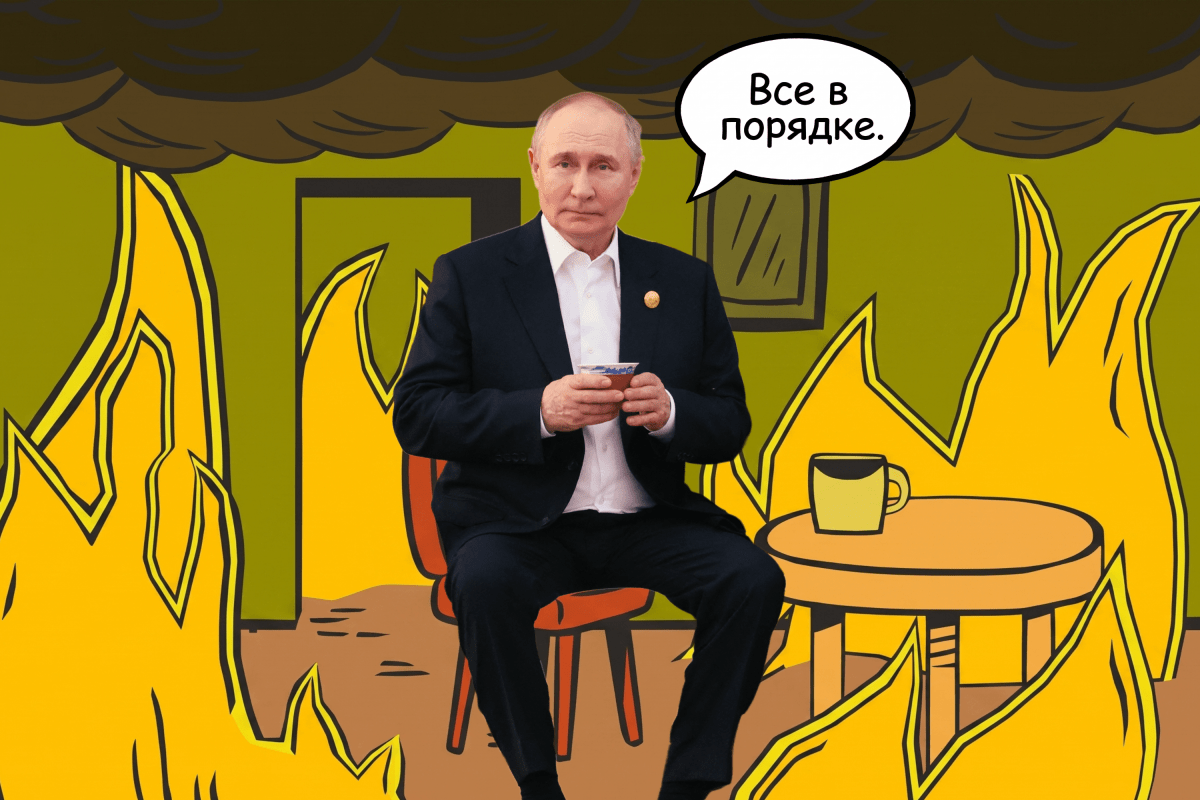
Putin knows he’s running his country into the ground; with elections around the corner, he just needs to make sure the people don’t. Andrei Klepach was hardly a fringe economist preaching Russia’s downfall. He was among Moscow’s most reputable experts, a man who’d served 10 years in Russia’s Ministry of Economic Development as a forecasting director and then deputy minister before joining VEB as chief economist in 2014.
During his glittering career, for which he was awarded the Order of Honor, he also held positions on the boards of Russia’s largest scientific and military-technical state companies, including Rosatom, the United Shipbuilding Corporation and the United Aircraft Corporation. This made him uniquely qualified to deliver his assessment of Russia’s technological and economic future; and what an assessment it was. In his report entitled "The Russian Economy and Geopolitical Challenges", he delivered four bleak conclusions, the last of which will have set alarm bells ringing in the Kremlin.
First: Russia’s current economic model cannot sustain a long confrontation with the West. Moscow, he argued, is trying to fight a costly war while simultaneously throttling the civilian economy with punishing interest rates and tighter budgets. "Under the macroeconomic policy being pursued…we will not withstand the confrontation," he said.
"The economy will stop, and society is unlikely to accept it." VEB’s own forecast put Russian growth at just 0.3 percent in 2026—in line with Central Bank forecasts of between 0 percent and 1 percent growth—with investment falling 2.5 percent. Second: Putin’s war is handing Beijing huge influence over Moscow. Klepach openly wondered whether Russia could even remain a sovereign power, or become a country with a "non-sovereign economy, overwhelmingly dependent on China." Its trade structure, he said, already showed an "extremely high degree of dependence" on Beijing; "in many respects higher" than Russia’s former reliance on the European Union.
Extract — continue reading at the source.