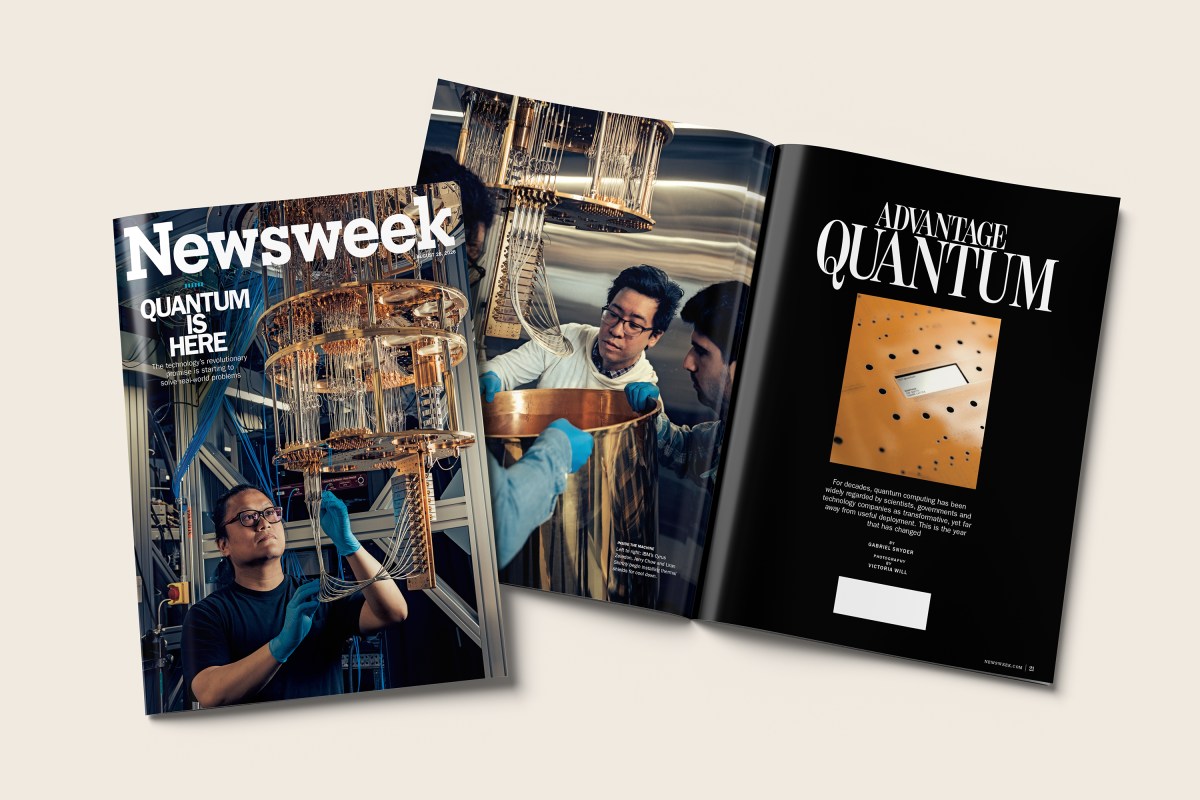
The hardest idea in quantum mechanics to hold in a non-physicist’s head is that a thing can be in two states at once. Not flickering between them too quickly to see but both, genuinely, at the same time, until someone measures and it settles into one. That contradiction turns out to be the best way to describe the decades-old argument over the state of quantum computing itself.
Quantum has been a technology that the Nobel Committee, the National Security Agency and half of Silicon Valley agree will rewrite what a computer can do. It is also, simultaneously, a thing so far from finished that it’s been safe to file away along with cold fusion and, until recently, artificial intelligence as technological marvels that are always at least 30 years beyond the horizon. An ordinary computer stores information in bits, which are switches with exactly two states: on or off, one or zero.
A quantum computer uses quantum bits, or qubits, which can be both at once. String enough of them together and the number of states they can hold simultaneously grows so fast that a few hundred of them can represent more possibilities than there are atoms in the observable universe. What you could do with a computer that runs on qubits has been a promise that science has been chasing for a very long time.
It has moved from theory into practice. Real-world commercial applications are no longer the stuff of imagination—from high-speed magnetic-levitation trains to quantum-powered navigation systems without GPS, and from better batteries and climate-friendly fertilizer to personalized drugs and precise tornado predictions. The people on the front line of the technology say this is the year it is really starting to happen.
In May 1981, at a conference on the physics of computation co-hosted by MIT and IBM, Richard Feynman stood up and told a room of computer scientists that they were going about it wrong. If you want to understand how the world actually works, he argued, ordinary digital machines will never be enough, because the world does not run on ones and zeros. Nearly a decade of public predictions produced a name for what it would take for this technology to prove itself as something beyond an academic curiosity—quantum advantage—and a year marked on the calendar: 2026.
Put simply, quantum advantage means the point at which a quantum computer solves some real problem—not a rigged puzzle built to showcase the hardware, but something someone needs an answer to—faster, cheaper or more accurately than the best classical computer can. What this means and how to measure it is contested. What is not contested is that the claim is now being tested in public instead of argued over in a seminar room.
Extract — continue reading at the source.