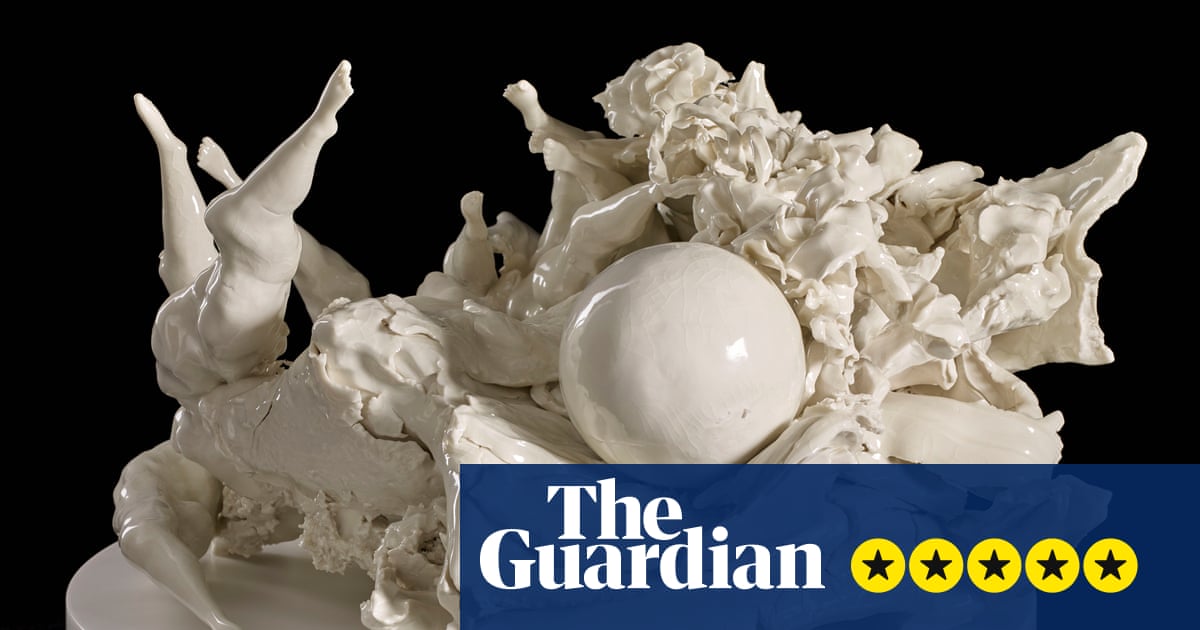
Maybe it was that wine glass I broke this morning while unloading the dishwasher, but seeing a Rachel Kneebone porcelain sculpture suspended makes me nervous. Can those skinny wires really hold the weight? Should there perhaps be a soft landing just in case?
Emerging from a tangled clump of ribbons and roses are a couple of bone-white bubbles, ready to pop. This is art that quite literally hangs in the balance; a sense of peril is what makes it so marvellous. Born in 1973, the British sculptor is the latest contemporary artist to be invited to show her work at the Wallace Collection.
Following in the footsteps of Damien Hirst, Flora Yukhnovich and Grayson Perry, Kneebone has positioned nine milky sculptures made between 2017 and 2026 throughout Hertford House. So this display, titled Metamorphoses, is an intervention – that’s the art world lingo. Except it feels different, like the contrast has been turned down.
Sure, there are collisions as well as similarities, but seeing sculpted heaps of human and floral forms alongside the prized masterpieces for which the London gallery is best known feels … right. Kneebone was studying at the Royal College of Art in 2004 when she started working with porcelain, a medium more commonly associated with the types of cups and saucers safely stowed away behind glass in Manchester Square. Instead, Kneebone gives us strangely intimate pileups that recall art historical sources from the sculptural fragments of Auguste Rodin to the erotic figures of Jake and Dinos Chapman.
Among the fleshly folds are glimpses of Ovid and Dante. While distinctly modern, they also nod to classical friezes, baroque fountains and, as is about to become abundantly clear, rococo canvases. One of two works that have been created specially for the show, Temple, is presented on a plinth at the top of the stairs.
Sandwiched between Boucher’s The Rising of the Sun (1753) and The Setting of the Sun (1752), it’s a lustrous, solid take on the churning waves the 18th-century French master conjures in paint. Emerging from the surf are three columns and a jumble of gnarly barnacles and tendrils, plus a gleaming scallop shell containing a pearl – a reference to Boucher’s bejewelled water nymphs. Just like those vast mythological scenes, it’s a mashup of decoration and high drama, pleasure and peril.
Extract — continue reading at the source.