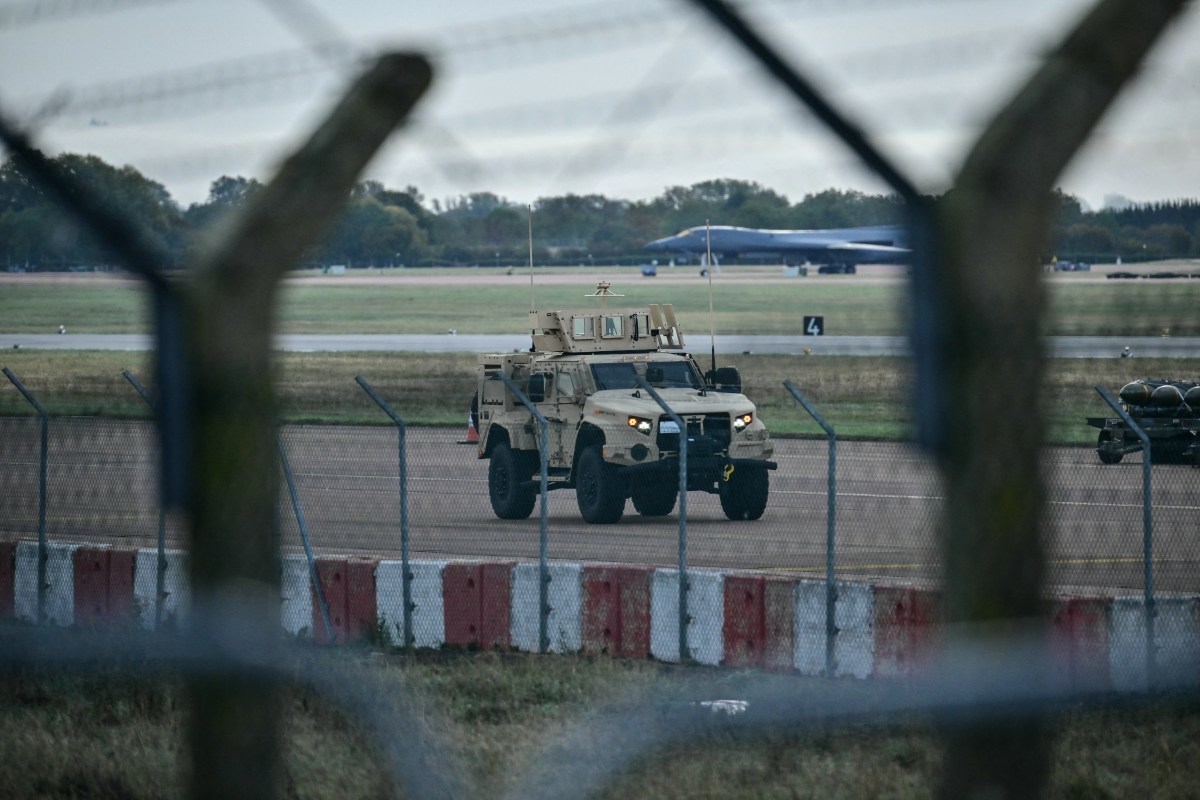
The disruption of an alleged plot involving explosives near a U.K. airbase considered a crucial node in America's global airpower network has raised concerns toward the vulnerability of one of the Pentagon's most important force projection assets. RAF Fairford hosts an array of U.S. warplanes, including B-1 and B-52 bombers operating in the U.S. war launched against Iran in February. At least equally as vital to the U.S. military's capacity to pursue this conflict and others across the globe are aerial tankers such as the KC-135 that have operated from the NATO ally base since the Cold War, allowing offensive aircraft to conduct sorties thousands of miles away.
With Iran having already inflicted extensive damage to U.S. bases in the Middle East, the strategic value of long-range refueling aircraft in Europe has only increased—as have the risks associated with open threats by Iran against RAF Fairford and other sites hosting them. And while no links have yet been established between Tehran and the five men arrested Sunday, accused of planning a potential attack at RAF Fairford, the implications of the incident highlight an uncomfortable reality about a blind spot in U.S. security abroad. "Because the United States military relies on the tanker aircraft to extend ranges, it is a point of vulnerability," Nora Bensahel, a U.S. defense expert and professor at the Johns Hopkins School of Advanced International Studies, told Newsweek.
And while such vulnerability has been traditionally associated by defense analysts with tankers being caught in the act of midair refueling, she said a realization has emerged that foes with the right tools would be "much better off damaging those planes before they ever take off than trying to engage them once they're airborne." "We are entering a period—if we're not already there, we will be—where those aircraft are going to be extraordinarily vulnerable on the ground, and any smart adversary that has the capability would choose to attack them on the ground before they take off," Bensahel said. "It's a very worrying military problem." Just how crucial the U.S. tanker fleet is to waging long-range operations can hardly be overstated. "In general, tankers are key enablers of modern air operations," Raphel Cohen, director of the RAND School of Public Policy's National Security Program and retired U.S.
Army reserve colonel who previously served on congressionally appointed National Defense Strategy commissions, told Newsweek. "That's because modern aircraft burn a lot of jet fuel, particularly in combat operations." "Especially if you want to fly aircraft from airfields that are further away from the adversary (which you often want to do so that they are out of attack range), you need to refuel aircraft enroute," Cohen said. "In some cases, you want aircraft to loiter over a target area—waiting for a target to pop up—but that too requires more fuel and by extension more tankers." Timothy Walton, senior fellow at Hudson Institute's Center for Defense Concepts and Technology who has participated in war-gaming scenarios for the U.S. and allies, told Newsweek described aerial refueling aircraft as "vital to modern U.S. air operations," including the ongoing conflict with Iran.
"Air Force, Army, Navy, and Marine Corps aircraft depend on aerial refueling," Walton said. Air Force employed more than 200 tankers in Europe and the Middle East during Operation Epic Fury alone in 2026, and it required scores of additional tankers to maintain strategic deterrence, defend the homeland, and address other theater, diplomatic support, training, and depot maintenance demands." Their role is not limited to the Persian Gulf. In the event of a large-scale conflict with China or Russia, Watson argued that the demand for tankers would be even greater in order to provide an air bridge bringing enemy territory within range.
But that demand also carries with it a major burden for a fleet that U.S. Transportation Command chief Air Force General Marshall Reed described in March—just weeks into the U.S.-Israeli war against Iran—as "the most stressed fleet that we have" in the U.S. military. Walton noted that the "Air Force’s 1950s-era KC-135 fleet is increasingly unreliable and expensive to operate and urgently needs replacement." And yet, "without effective aerial refueling, U.S. forces could be severely constrained in a conflict," he said.
Extract — continue reading at the source.