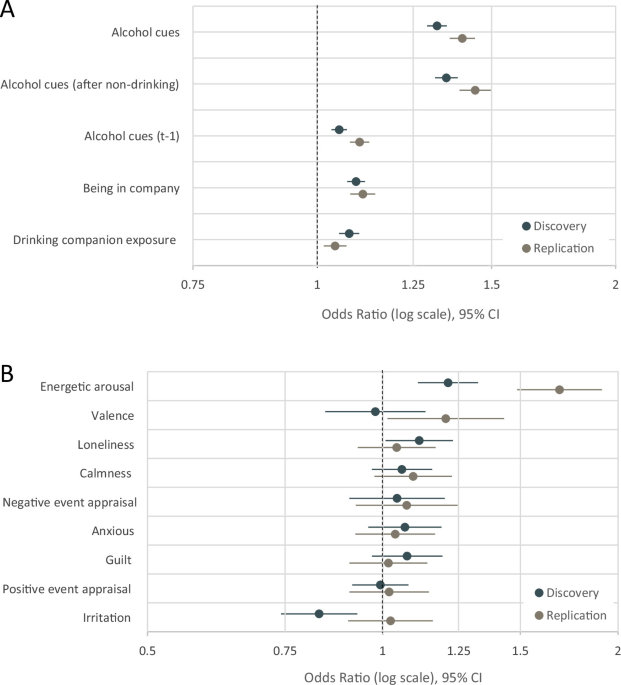
Alcohol-related cues are thought to contribute to drinking in alcohol use disorder (AUD), but their contribution in daily life remains difficult to separate from changing social contexts and internal states. We used ecological momentary assessment in two independent cohorts of non-treatment-seeking individuals, comprising a discovery cohort with AUD (17–62 years; n = 73) and a young-adult replication cohort screened for risky drinking (19–35 years; n = 56), to test whether alcohol cue exposure was associated with momentary drinking after simultaneous multivariable adjustment for social context, affective states, and event appraisal. In logistic mixed-effects models, within-person exposure to alcohol-related cues was significantly and reproducibly associated with higher odds of drinking in both cohorts.
Being in company, exposure to drinking companions, and higher energetic arousal also showed reproducible within-person associations with drinking. Exploratory clustering of participant-specific slopes suggested meaningful alcohol cue-reactive and social context-reactive risk profile candidates. These findings identify alcohol cue exposure as a robust daily-life correlate of drinking and suggest candidate phenotypes motivating future validation studies of more personalized, context-aware interventions for AUD.
Alcohol use disorder (AUD) is a significant contributor to the global burden of disease and mortality [1, 2]. Given that alcohol consumption is episodic and context-dependent, identifying correlates of drinking in daily life is essential [3]. Alcohol-related cues, in particular, are important proximal correlates of drinking [4, 5].
In incentive-sensitization and neurocircuitry models of addiction, such conditioned cues increase the likelihood of alcohol use by acquiring motivational salience, biasing attention, and evoking craving and approach behavior [6]. However, retrospective reports on drinking and related contexts are limited by recall bias and temporal aggregation [7]. Ecological momentary assessment (EMA) can address these limitations by capturing experiences and behaviors in daily life and real time [7, 8].
Indeed, previous real-world studies have linked daily or momentary exposure to alcohol cues with craving and drinking [9, 10]. However, these studies have typically examined narrower subsets of co-occurring influences. For example, Meredith et al. [9] examined cue exposure and mood states in once-daily retrospective reports of drinking quantity, whereas Kohen et al. [10] examined cue exposure, postdrinking status, and trait-level alcohol sensitivity with craving as the outcome.
Additionally, social context [3, 11] and arousal [12] have also been linked to drinking in EMA research, but typically as focal predictors rather than as simultaneous covariates alongside cue exposure, affective states, and event appraisal. Accordingly, it remains unclear whether alcohol cue exposure shows a specific within-person association with momentary drinking when changing social context, affective states, arousal, and event appraisal are modeled simultaneously, and whether such an association replicates across independent cohorts. Beyond average effects, alcohol cue-reactivity is heterogeneous across individuals.
Extract — continue reading at the source.


