Scientists cooled a collection of atoms to about 10 picokelvins, or 10 trillionths of a kelvin. That’s barely a smidge above absolute zero (−273.15° Celsius). The atoms formed a Bose-Einstein condensate, a quantum state of matter, colder than any before, researchers report November 5 in Science.
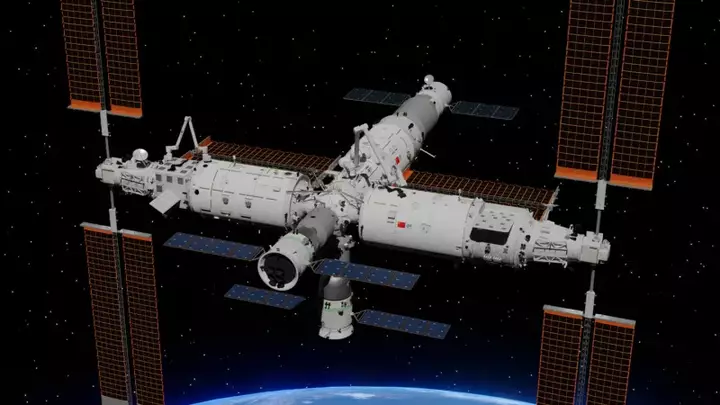
To achieve that record-low chill, scientists took their work to space. The atoms orbited Earth aboard China’s Tiangong space station. There, researchers used laser-based traps to contain 20,000 rubidium atoms and reduce their motion, thereby cooling them.
At an atomic level, temperature is tied to motion: Atoms and molecules in the air around us move more slowly when it’s colder. Similarly, in systems of cold atoms, scientists can define an effective temperature based on how slowly the atoms spread apart when they are allowed to expand. On Earth, gravitational forces cause clouds of atoms to sag, reducing the effectiveness of cooling.
But on the space station, the atoms experienced microgravity, the apparent weightlessness of an object in free fall. To make a Bose-Einstein condensate, a disorderly gaggle of atoms is cooled until the atoms all take on the same quantum state, acting as one entity. By experimenting with ultracold atoms, researchers can study exotic states of matter and other mysterious physics.
And they can test fundamental concepts, such as the equivalence principle — the idea that explains why objects of different masses fall at the same rate in a vacuum. Spacefaring Bose-Einstein condensates were previously made on the International Space Station, at effective temperatures as low as 52 picokelvins. And an experiment on Earth, in which atoms were dropped down a tower to induce weightlessness, reached 38 picokelvins.
But drop tower experiments are limited by the time their free fall lasts. That’s not an issue for experiments in Earth’s orbit. So cold atoms in space are really taking off.
Extract — continue reading at the source.