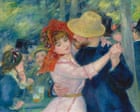
There are broken clay-pipes too beneath the swirling pink skirts and blue trousers of the couple in his tall, narrow 1883 canvas Dance at Bougival as they bring their faces close, placing their arms around each other and pirouetting in the soft, airy space Renoir makes you feel as well as see. It’s an outdoor afternoon dance enclosed by fluffy, lime-coloured trees. A couple sitting at a table get friendlier with each swig of beer.
Renoir seems to have invented the slow French lunch, relaxed and liquid, that launched a thousand bistro daydreams. In After the Luncheon, another one to delight Hockney, we see a white-clothed, open air table neatly arranged with porcelain coffee cups, carafes and glasses – and a woman sipping a liqueur while the bearded man she’s lunching with lights up, savouring the moment as his cigarette end glows fire-red against the pale blues, whites and silvers. The Lunch at the Restaurant Fournaise (The Rowers’ Lunch) lingers on the same climactic moment, one man lounging back in tobacco reverie while the lovers or about-to-be-lovers on the other side of the table chat soulfully.
Pierre-Auguste Renoir, who was born in 1841 and lived until 1919, saw the height and fall of the French bourgeois civilisation whose pleasures he so infectiously celebrates. His son, the film director Jean Renoir, revisits his father’s world with the sadness of hindsight in his screen recreation of an impressionist picnic, Partie de Campagne: there you know the happiness is fragile. But in Pierre-Auguste’s paintings, there’s no punishment.
Nobody gets syphilis or drinks themselves to death, or drowns in the Seine. This is the happiest art exhibition of the year. Renoir, this perfect exhibition lays bare, is the most radical of the impressionists, which will come as a shock to anyone who sees him as the soppiest and most kitsch.
Impressionism started as a pejorative label chucked at a loose group of artists in 1870s France who tried to capture modern life in motion. It is Renoir who most enthusiastically embraces this as a philosophy of life itself. He doesn’t just paint the changing light of the passing moment.
He urges us to live in it. This ideal of enjoying life as it comes makes his masterpiece Dance at the Moulin de la Galette, lent by the Musée d’Orsay, as grand as a history painting and as light as a souffle. As hosts of people take pleasure in each other’s company in this open air hangout in Montmartre, their flirtations, longings and consolations are caught in a dappled, mobile dance of golden light and cool shadow.
Extract — continue reading at the source.


