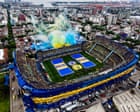
Ever since the Observer Sport Monthly published a list of 50 sporting things you must do before you die with Watch Boca Juniors Play River Plate in Buenos Aires at No 1 in 2004, the biggest super derby in Argentina has been firmly positioned in the global imagination; its reputation for colour, passion and uncontainable emotion acquiring an almost glamorous sheen. The thump and thud of the coordinated chants, the shiny ticker-tape amid flare smoke matching the teams’ strips, the bounce of the concrete as tens of thousands jump in unison, mounted police surrounding the stadium, avalanche stoppers set alight, rockets aimed at players; blood and fire. Things have changed, though, and Sunday at La Bombonera (Boca’s stadium known as the Chocolate Box) was quite a different spectacle.
Since 2013 football matches in Argentina have been played without visiting fans, so for starters the colour palette has been greatly reduced. The absence of the opposing tribe has been welcomed by many, making the experience of going to a football match more family-friendly and increasing ticket availability for club members. As we shared a choripán in a corner grill before the game, the Argentinian journalist Ezequiel Fernández Moores recalls the first Superclásico without away fans, at the Monumental in 2013.
As Boca’s Emmanuel Gigliotti scored to give the away team the lead, in the press area Moores heard the beginning “G” of someone ready to shout the goal with glee, suddenly realising “non-home joy had to be repressed”. Over the years the absence of away fans has been mirrored in an absence of away press. Now the journalists sit at their desks along the same height as the middle tier of the traditional home end, where the heart of the hardcore organised gang known as La Doce leads the rhythm section, creating a sense of continuum, with hacks clad in Boca strips cursing and cheering along with the crowd.
Rain had been forecast for Sunday so Boca distributed blue and yellow umbrellas which opened in sync and matched the colour of the smoke from the fireworks organised by the club. The pyrotechnics used to be smuggled in by La Doce, who would also orchestrate the release of blue and golden balloons at the exact time the players emerged from the tunnel. When I went to pick up my accreditation, the head press officer announced to no one in particular that this “Señora” (meaning me) had once interviewed José Barritta.
A young man holding a newborn baby and a couple of kids who looked barely out of school just stared. Barritta was the infamous leader of La Doce decades ago and in 1994 I did indeed spend the afternoon with him to write a colour piece about the Superclásico from the “middle tray” (the terraces are tiered in three balconies and the middle one is the centre of operations). It was an afternoon that would end in tragedy with two River Plate fans shot dead after the game.
Disgustingly, graffiti emerged nearby soon afterwards reading “River 2 Boca 2”, equating two young lives to the two goals River had scored against Boca securing their victory. My feature was shelved and instead I became a witness to the fact that Barritta had not been involved, my work published in a human rights journal, and my interest in football-related violence swiftly losing the wide-eyed fascination. Death at the Superclásico was not something new, even then.
Extract — continue reading at the source.