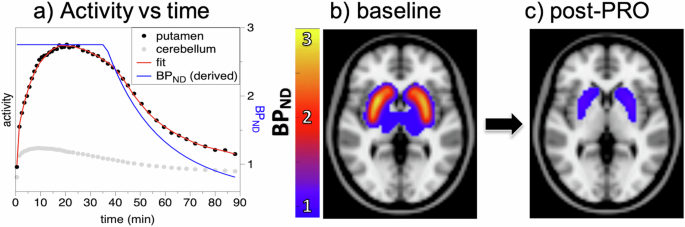
The dopamine D2-receptor antagonist prochlorperazine is approved clinically as both an antipsychotic and an antiemetic. Classical antipsychotics like prochlorperazine have been shown to treat the positive symptoms of schizophrenia at occupancies higher than 60% with extrapyramidal symptoms occurring at occupancies over 80%. As an antiemetic, this drug is known to carry a high risk of akathisia and some risk for more severe extrapyramidal symptoms, but the relationship between dosage and D2 receptor occupancies has not been reported.
The functional consequences of D2 receptor binding at different occupancy levels also remain unexplored in human subjects. In this study, we performed simultaneous PET and MRI to measure receptor occupancy by competition with [11C]raclopride and to assess the concurrent functional hemodynamic response versus prochlorperazine dosage. Additional studies in non-human primates (NHP) were performed for comparison and dose flexibility.
In human subjects, the effective dose to achieve 50% occupancy was 1.2 mg/100-kg, indicating that a clinical dose of 10 mg will achieve occupancies greater than 80% in virtually all subjects. In both human subjects and NHP, functional MRI responses showed a rapidly escalating response at occupancies larger than about 60%, a response consistent with autoreceptor-mediated dopamine release. These results provide a functional correlate for the lower edge of the antipsychotic therapeutic occupancy window and confirm that D2 receptor antagonism is ineffective at attenuating post-synaptic function at low occupancies.
Prochlorperazine (PRO) is a first-generation antipsychotic medication that is also approved by the FDA for use as an antiemetic agent. Among injectable first-generation antipsychotics, PRO provides a relatively short duration of action and has been widely used clinically, which are desirable characteristics for imaging studies in human volunteers using this class of agents. However, PRO carries a well-documented risk of extrapyramidal symptoms, including tardive dyskinesia and akathisia [1,2,3,4].
Risks for adverse effects are expected to increase when the drug occupies a large fraction of its primary target, the dopamine D2 receptor (D2R). Positron emission tomography (PET) studies of first-generation antipsychotics have informed dosing regimens and established the concept of a therapeutic window in which clinical efficacy requires occupancies above approximately 60%, while extrapyramidal symptoms emerge above roughly 80% [5,6,7]. Yet, no prior studies have reported human occupancies achieved by clinical doses of the injectable form of this medication.
PET-based occupancy measurements have been foundational for understanding first-generation antagonists and have extended to differentiate subsequent generations defined by lower D2R occupancies with high binding at other receptors (e.g., clozapine) [8] or by very high D2R binding for the third-generation partial agonist aripiprazole [9, 10]. While these studies reported target engagement, they did not provide imaging markers of brain function. The advent of simultaneous PET/MR imaging created the opportunity to supplement measurements of receptor occupancy with concurrent MR-based assessments of drug-induced functional changes, as demonstrated for the dopamine (DA) system [11, 12] and other neuroreceptor systems [13, 14].
Extract — continue reading at the source.