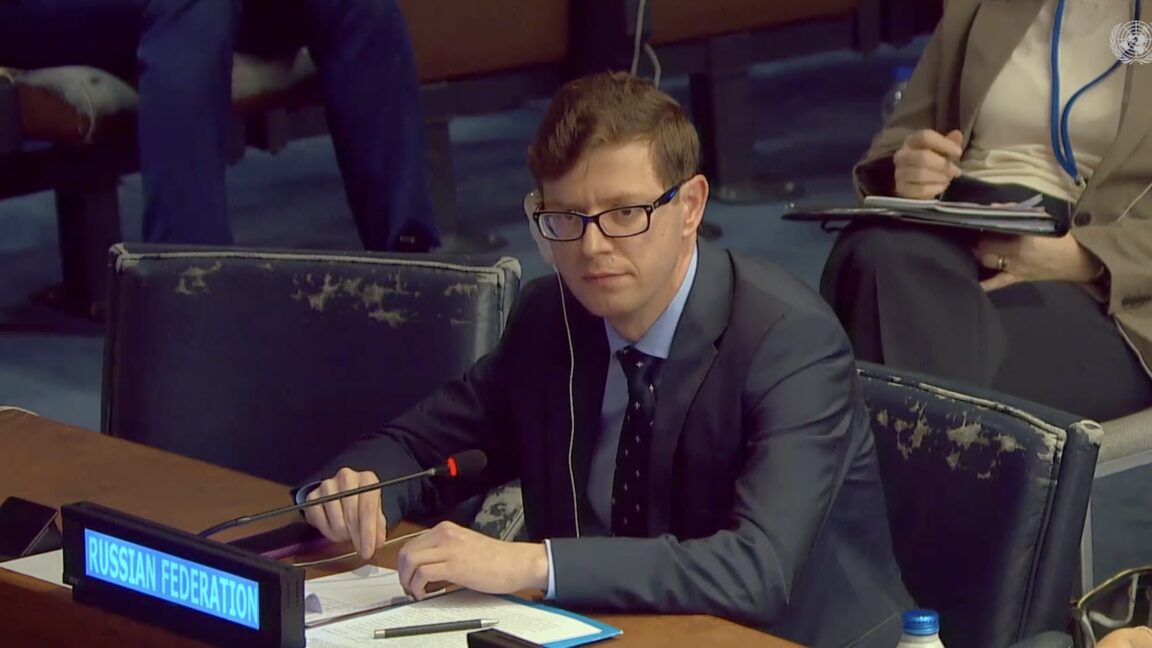
Four years ago, a senior official in Russia’s foreign ministry painted a bullseye on commercial satellite networks that assist Ukraine in its fight against invading Russian military forces. On Wednesday, several days after a Russian military spacecraft moved within striking distance of one of those commercial satellites, the same Russian diplomat assured the world there’s no reason to worry. There’s a sharp incongruity in those statements from Konstantin Vorontsov, deputy head of Russia’s delegation to the United Nations.
Vorontsov’s comments Wednesday in the UN General Assembly’s First Committee came moments after a US official called attention to recent maneuvers by Kosmos 2612, a Russian military craft that approached a US-registered commercial satellite some 340 miles (550 kilometers) above Earth. The decision to conduct these activities was deliberately reckless and violated long-established safety thresholds in low-Earth orbit.” Thomas DiNanno, the US Under Secretary of State for Arms Control and International Security, shared a similar statement on X. The comments were the first by the US government since the close encounter last weekend.
Vorontsov said the US government’s concerns, echoed by European officials, were “unfounded” distractions. At that time, as Ukraine ramped up its reliance on commercial satellite communications and surveillance, Vorontsov said that commercial space infrastructure used by Ukraine’s military, including Western satellites, could be a “legitimate target for a retaliatory strike.” It is no wonder, then, that the Russian military’s unprecedented maneuvers near one of those satellites raised alarms. Since its launch in April, Kosmos 2612 performed a series of carefully choreographed rocket burns to match orbits with ICEYE-X36, a radar surveillance satellite owned by the US subsidiary of the Finnish remote sensing company ICEYE.
Extract — continue reading at the source.