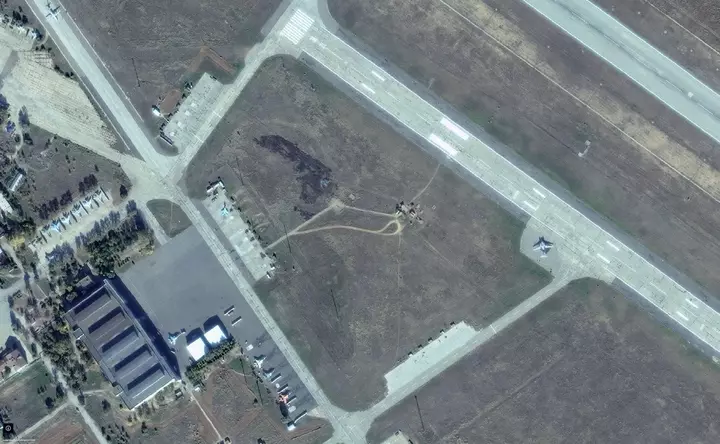
The Su-57's engines were starting up when the incident occurred at the Akhtubinsk airfield in the Astrakhan region on October 29, Ukraine's GUR military intelligence agency said on Monday. The Russian Defense Ministry did not respond to a Newsweek request for comment on Ukraine's claims. Two Su-57s and an older fighter jet are visible on a parking apron at Akhtubinsk airfield on October 28.
Two days later, commercially available imagery shows the same parking area is empty, while a heavily damaged Su-57 sits in a patch of scorched earth. It is not clear what happened to the second Su-57 glimpsed at the airfield prior to the suspected explosion. Moscow hails the Su-57 as its most sophisticated and difficult-to-detect jet, painting it as a rival to the U.S.
Both are known as fifth-generation aircraft, which is the most cutting-edge raft of fighter jets currently in operation. But many Western aviation experts doubt whether the Su-57 is stealthy enough to be in this category. While Russia has sometimes wielded its Su-57s to launch long-range strikes against Ukraine since the start of its full-scale invasion in February 2022, Moscow has carefully held the jets back from the reach of Ukrainian air defenses—apparently reluctant to risk losing any of the aircraft that come with a price tag roughly $150 million apiece.
Russia had approximately 21 Su-57s in operation by the start of 2026, according to the British defense think tank, the International Institute for Strategic Studies. However, further production has been tripped up by the pressure of the grinding war against Kyiv. Ukrainian authorities say two Su-57s were damaged by Ukrainian drones in May, while Russian media reported in July that another Su-57 had crashed near Moscow during a routine training flight.
Russia's Defense Ministry said a training aircraft had crashed while taking off from the area around the capital but did not specify the type of aircraft and said the pilot had safely ejected. Ukraine's GUR said the engines fitted into the Su-57 can "explode or undergo catastrophic destruction" when filled with low quality jet fuel but did not directly attribute this to the claimed explosion. Ukrainian officials say Russia has leaned on imports of aviation fuel because of Ukraine's sustained campaign of drone strikes against Russian oil refineries.
This is despite pressure from U.S. President Donald Trump for Kyiv to stop the attacks aimed at curbing Russia's ability to fund its war. Akhtubinsk sits around 400 miles from the Ukrainian front lines, and Ukraine has targeted the military site at least three times in almost five years of all-out war.
Extract — continue reading at the source.