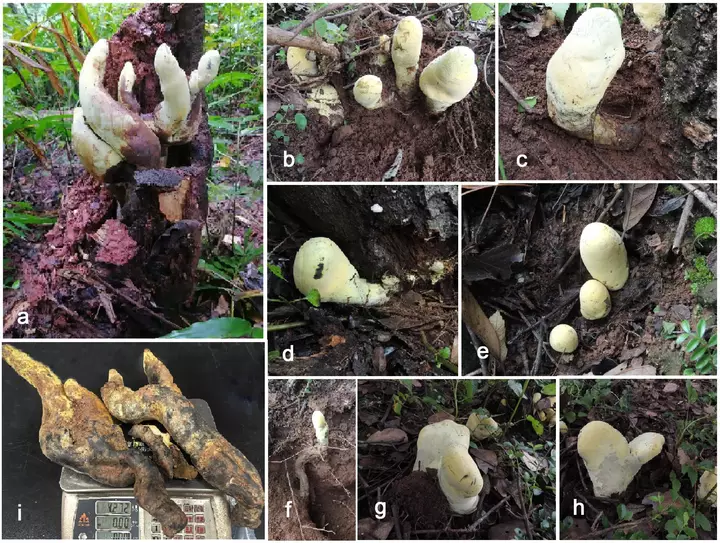
This article has been reviewed according to Science X's editorial process and policies. Editors have highlighted the following attributes while ensuring the content's credibility: Deep in the forests of Yunnan, China, scientists have discovered a "fungal giant" that challenges our understanding of how large fungi can become. The newly described species, Dianjunus rex, produces vertical fruiting bodies up to 50 cm (20 inches) high and weighing up to 2.2 kg (4.9 pounds)—the largest known within the phylum Ascomycota.
"This remarkable species represents a new fungal family, Dianjunaceae, and provides a rare window into the evolution of extreme fungal body forms," said Dr. Senanayake, an associate professor at the Germplasm Bank of Wild Species of the Kunming Institute of Botany in China and corresponding author of the new study, published in Frontiers in Fungal Biology. "The discovery illustrates how much fungus biodiversity remains to be discovered in East Asian forests." During fieldwork in temperate coniferous forests near Damaidi and Yipinglang and in tropical rainforest near Nanbang, scientists from the Kunming Institute of Botany found large whitish fruiting bodies ('stromata') clearly belonging to an unknown ascomycete fungus.
These grew on woody roots of Chinese cork oak, emerging from the rhizosphere. Ascomycetes, the largest group of fungi with more than 64,000 species, don't grow true mushrooms but instead release spores from tiny, sac-like structures inside or on the surface of such fruiting bodies. The scientists collected the fruiting bodies and deposited voucher specimens in the collections of the Kunming Institute of Botany.
They grew spores on media to study the morphology of the fungus and also sequenced its genome, including the ensemble of protein-coding genes. Genetic results confirmed by a detailed study of its morphology revealed that the fungus represented a new species, a new genus and even a new family (Dianjunaceae) within the order Xylariales. The authors named it Dianjunus rex, for its regal size and the ancient Dian kingdom.
The closest known relative to "D-rex" is Graphostroma platystoma, which grows on dead hardwood across the Northern Hemisphere and by itself forms the family Graphostromataceae. Xylariales are famous for their production of secondary compounds as well as enzymes which can degrade complex plant molecules. Such enzymes might likewise help "D-rex" to digest dead wood.
Using a "molecular clock" analysis of the new species' DNA and comparing it with the genomes of hundreds of fungi with known evolutionary ages, the authors were able to estimate that the Dianjunaceae arose around 65 million years ago. Strikingly, this is only one million years after the Cretaceous-Paleogene mass extinction event—famous for wiping out the dinosaurs besides countless other animals and plants. "This timing raises an intriguing possibility.
Extract — continue reading at the source.