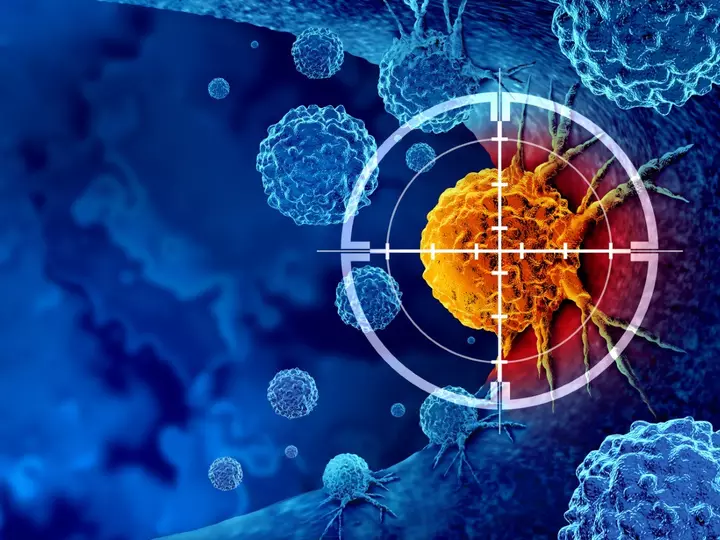
Researchers have found that when cancer cells are compressed or tightly confined, they begin a process that results in their self destruction. Experts at Fudan University, Sun Yat-sen University and the Chinese Academy of Sciences in Shanghai used three dimensional models to uncover how cancer cells responded when mechanically confined for prolonged periods of time. They saw that the cells, when trapped in tight spaces, underwent a kind of chronic stress response that affected their metastatic behavior - which enables them to spread - and resulted in cell death.
The study was published in the Cell Press journal Developmental Cell on October 14. The researchers looked at cancer cells undergoing a specific stage of development known as the mesenchymal-to-amoeboid transition (MAT)—a rapid biological process where cells adapt to fit through tighter spaces in their environment without genetic transcription needing to happen. One of the biggest physical challenges cancer cells face during metastasis is "squeezing through extremely narrow spaces as they escape the primary tumor and invade surrounding tissues," study authors Liming Sun and Yan-Jun Liu told Newsweek.
They said that they designed a system that models that challenge, whereby the cells were "gently compressed into a very thin space while being unable to attach to surrounding surfaces, closely mimicking this stressful journey." They kept them under those conditions for several hours. This enabled them to "follow their entire journey—from initially switching into a fast-moving, amoeba-like state in an attempt to escape, to our unexpected discovery that prolonged confinement eventually caused them to stop moving and activate a built-in cell death program," they said. Essentially, as the cells were exposed to increasing levels of pressure during this stage, they appeared to identify this change in their environment as dangerous, releasing signals that trigger cell death.
The persistent physical confinement therefore seemed to place long-lasting stress on these cells and the researchers noticed that the stress eventually activated MLKL (which stands for mixed lineage kinase domain-like), which triggers cell death. "Interestingly, before the cells died, they first lost their polarized shape and ability to move, effectively stopping their invasive behavior," Sun and Liu said. However, at this stage they also noted that this process "removes MLKL-high cells, tumors progressively enrich for MLKL-low, necroptosis-resistant clones that are more aggressive." They also tested this mechanism across multiple cancer cell types and observed similar responses, which Sun and Liu said suggested "this may represent a broader principle of how tumor cells respond to prolonged physical stress." "However, the extent of this response may vary depending on the genetic background and characteristics of different cancers, and further studies will be needed to understand these differences," they added.
The study authors told Newsweek that the findings suggest that prolonged mechanical stress within tumors "can act as a natural barrier against cancer cell dissemination," and the process both "eliminates highly invasive tumor cells and promotes immune recognition of the tumor." They said that MLKL expression itself "may serve as a biomarker of tumor progression and metastatic potential," as in the study, cancer cells with higher MLKL expression were "more susceptible to this intrinsic mechanical checkpoint, whereas cells with lower MLKL expression were more likely to survive prolonged confinement." "Over time, this selective pressure may favor the expansion of these escape clones, which tend to exhibit greater migratory and invasive potential," they said. "Measuring MLKL levels may therefore help assess how tumors evolve during disease progression." These findings could translate into new therapeutic strategies, they added. "One possibility is to pharmacologically activate MLKL, which could amplify MLKL-dependent necroptosis, potentially boosting the elimination of cancer cells exposed to prolonged mechanical confinement." More broadly, they said the study suggests that "therapies should not only target biochemical signaling pathways but also exploit the unique mechanical environment of solid tumors." "By combining approaches that restore or activate MLKL with conventional cancer therapies, it may eventually be possible to reinforce the body's own built-in defense against metastasis," they said.
Zhang W, Wang Y, Zuo C et al (2026) Long-term confinement triggers RIPK3-independent necroptosis in amoeboid cancer cells to shape tumor evolution Developmental Cell. https://www.cell.com/developmental-cell/fulltext/S1534-5807(26)00351-5 Contact Newsweek editors on this story: Kara Dolman and Paul Donnelley.
Extract — continue reading at the source.