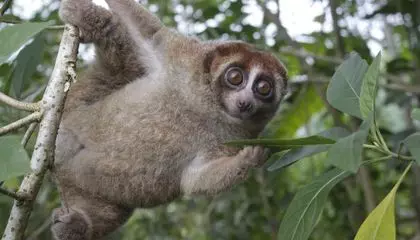
A small primate that scientists feared might be extinct has been making appearances across an Indonesian island, offering new hope for the elusive species. The Bangka slow loris was last officially documented by scientists in the 1930s. As a result, in 2015, the International Union for Conservation of Nature (IUCN) classified the species as critically endangered—and possibly extinct—on its Red List of Threatened Species.
But a new study published in October in the journal Spixiana shows the Bangka slow loris continues to survive in the wild. Scientists report that a local wildlife organization on Bangka Island, Indonesia, has rescued and re-released dozens of Bangka slow lorises in recent years. While the species still faces numerous threats, the research suggests it’s not yet extinct—rather, it was simply “overlooked by science for nearly a century,” study co-author Timon Glaw, a conservation biologist at the Haus des Meeres Aqua Terra Zoo in Austria, tells Mongabay’s Naina Rao.
Based on the findings, Glaw and colleagues recommend a formal reassessment of the species’ status to remove the “possibly extinct” label. Diminutive, nocturnal and cryptic, the Bangka slow loris is native to the Indonesian island of Bangka, as well as southwestern Borneo. These creatures have huge eyes, stubby tails, reddish-brown fur and distinctive facial markings.
They move slowly through trees, likely feeding on bugs, tree gums, nectar and other plant parts. The Bangka slow loris and some other slow loris species have evolved an unusual way of defending themselves: They produce a toxic secretion from glands on their upper arms. When threatened, they lick these glands, mixing the secretion with proteins in their saliva to create venom.
They then transfer the toxin to their specialized front teeth, allowing them to deliver a venomous bite when necessary. The second tongue helps clean the animal’s forward-projecting bottom teeth, collectively called the toothcomb. It’s primarily used for grooming—but also for its venomous bite.
For decades, scientists didn’t know whether the species continued to survive on Bangka, a tropical island east of Sumatra with more than a million residents. The last scientific paper to mention the Bangka slow loris was published in 1937, although it may have drawn on specimens collected even earlier, between 1930 and 1932. To better understand the species’ current status, scientists analyzed data collected by the Alobi Wildlife Rescue Center, a nonprofit conservation and rehabilitation facility on Bangka.
Extract — continue reading at the source.