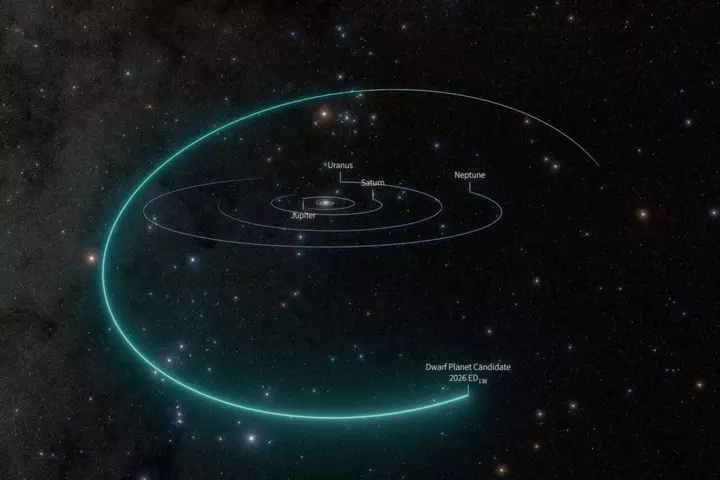
Rubin Observatory have announced that they have spotted a possible new dwarf planet known (for now) as 2026 ED138 orbiting the sun, located just beyond Pluto. The discovery comes just months after the Vera C. Rubin Observatory, which is based in Chile and funded by the U.S.
National Science Foundation and the U.S. Department of Energy’s Office of Science, began its 10-year Legacy Survey of Space and Time (LSST) in late June. The project will “relentlessly” photograph the southern sky over the next 10 years, creating a time-lapse of the universe, allowing scientists to spot objects that move or change and potentially uncover previously unknown objects in the solar system. 2026 ED138 was found by Matthew Holman, of the Center for Astrophysics (CfA), while he was examining observations collected by the Rubin observatory earlier this year.
On October 13, Holman ran the observations through computer software designed to find distant objects moving across the sky. Holman said, “my first reaction was one of excited disbelief,” adding that “objects like this are very rare, so I immediately started checking whether I or the code had done something wrong.” Newsweek has reached out to Holman for comment. After the potential discovery emerged, scientists trawled back through the catalog of Rubin images, taken from March to July, and were able to find the object in more than 20 observations.
Its distance places it beyond Pluto's orbit, and early estimates indicate that it could be one of the largest and brightest objects that’s ever been found in that distant part of the solar system. Scientists estimate that ED138 could be between about 600 and 1,500 kilometers (370 to 930 miles) across, based on its distance, brightness and estimates of how much light its surface reflects. Objects that are that big are expected to be rounded by their own gravity, an important requirement for an object to be considered a dwarf planet, however more observations will be needed to establish its true size and determine whether it qualifies.
ED138 is currently around 46 times further from the sun than Earth is, putting it further out into the solar system than Pluto's average distance, which is roughly 40 times further from the sun than Earth is. Its location may also help explain why such a large object has remained undetected. ED138 appears against a crowded part of the sky near the plane of the Milky Way, where huge numbers of stars can make moving objects difficult to identify.
The potential dwarf planet is the latest addition to a rapidly growing list of solar system objects discovered using Rubin data. Remarkably, more than 11,000 new asteroids were discovered before the main 10-year survey had even started. In April, the observatory announced that scientists had submitted around 1 million observations to the International Astronomical Union's Minor Planet Center, covering more than 11,000 previously unknown asteroids as well as over 80,000 known objects.
Extract — continue reading at the source.