Around the world, billions of people still lack reliable access to safe drinking water. The United Nations estimates that 2.2 billion people do not have safely managed drinking water, while regions from California to the Middle East increasingly rely on desalination plants to turn ocean water into fresh water. Desalination can provide a critical water supply, but today's most common methods come with significant drawbacks.
Reverse osmosis forces water through specialized membranes to remove salt, while thermal distillation uses heat to separate fresh water from seawater. Both approaches can consume large amounts of energy, often require water treatment before and after the process, and generate a highly concentrated salty waste known as brine. When that brine is discharged back into the ocean, it can increase local salinity and reduce oxygen levels, creating harmful conditions for marine organisms.
A Solar-Powered Alternative to Conventional Desalination Researchers at the University of Rochester have developed a different approach that could help address several of those problems at once. Scientists at URochester's Institute of Optics created a solar thermal desalination system designed to produce fresh water efficiently without generating liquid brine or requiring chemical additives to pre-treat the incoming water. The method is described in a paper published in Light: Science & Applications.
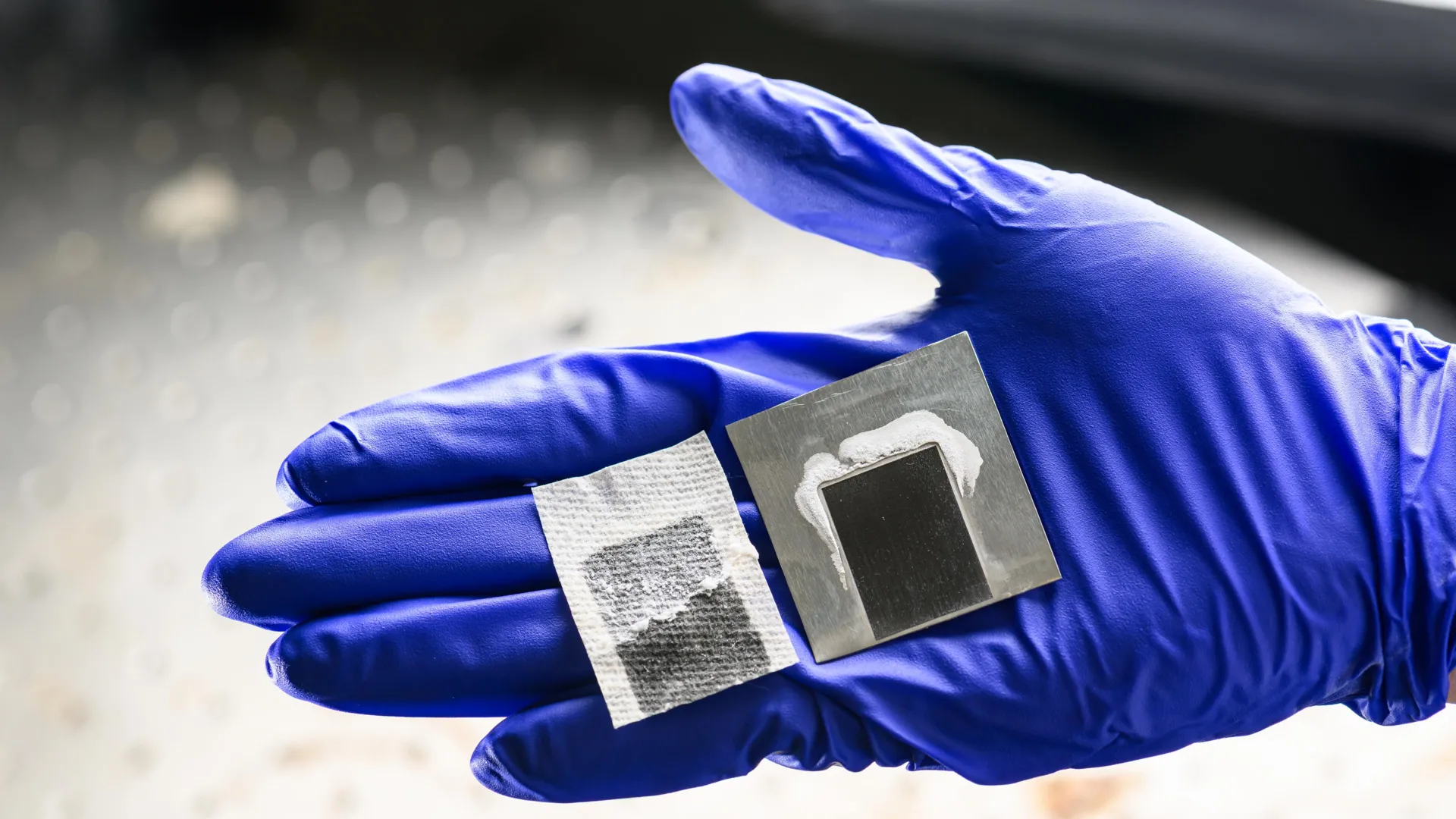
The research was led by Chunlei Guo, a professor of optics and physics and a senior scientist at URochester's Laboratory for Laser Energetics. At the heart of the technology are solar panels made from black metal that has been treated with femtosecond lasers. A femtosecond is an extraordinarily short unit of time, equal to one quadrillionth of a second.
Pulses from these ultrafast lasers can precisely alter a material's surface, creating microscopic structures that dramatically change how it interacts with light and water. The laser treatment makes the metal extremely effective at absorbing sunlight and also gives it superwicking properties, meaning water spreads rapidly across the surface instead of beading up. Each panel contains a laser-treated active region that draws a very thin layer of seawater across its surface.
The dark metal absorbs nearly all of the incoming solar radiation, heating the water and causing it to evaporate. That evaporation leaves salts and other dissolved minerals behind. Rather than allowing those materials to accumulate where evaporation is taking place, the panel directs them toward untreated areas along its sides, known as the passive region.
Extract — continue reading at the source.