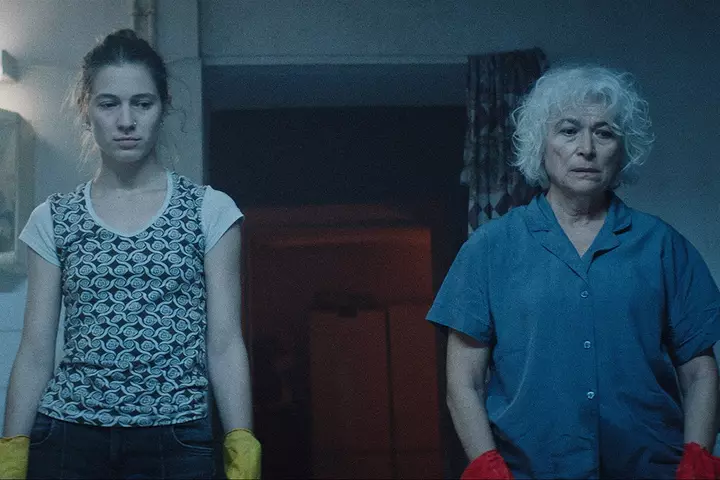
Inspired by films including 'The Postman Always Rings Twice' and 'Thelma & Louise,' the third feature from 'Wednesday 04:45' director Alexis Alexiou screens at the Thessaloniki Film Festival Greek filmmaker Alexis Alexiou arrives at the Thessaloniki Intl. Film Festival with his third feature, “Sea of Glass,” fresh off its premiere out of competition at Edinburgh. The moody, noir-infused drama will have a special screening in Thessaloniki before a limited theatrical release across Greece on Nov. 12.
Best known for the Tribeca-premiering “Wednesday 04:45” — a sleek, Athens-set crime thriller that wore its debt to Michael Mann on its neon-infused sleeve — Alexiou’s latest unfolds in the off-season at a down-at-the-heels resort town on the island of Evia, an atmospheric locale for what he describes as a “country gothic noir.” The film stars Evangelia Andreadaki (“Arcadia,” “Little England”) as Vangelio, a 65-year-old who’s trapped in the thankless routine of caring for her abusive, bedridden husband. A prisoner in her own home, she makes do with leafing through her collection of old guidebooks and dreaming of the sea. But then the sudden death of her husband encourages her to make a “reckless” decision: to go on holiday.
Booking a room at a shabby resort on the outskirts of Chalkida, the capital of Evia, she meets Vicky, played by newcomer Christiana Matelska Toka, a tough-as-nails twentysomething who runs the family business while looking after her alcoholic father (Michalis Iatropoulos). When his bullying nature turns violent one night, Vangelio steps in to protect the young woman, setting the stage for a stormy confrontation — and an eventual flight for liberation. Alongside the main stars, it features Nikos Georgakis (“Truants”), Thanos Tokakis (“Tokakis or What’s My Name”) and Dimitris Tzoumakis (“Wednesday 04:45”).
Simon Sarketzis (“Little England,” “Behind The Haystacks”) served as cinematographer. Speaking to Variety ahead of the Thessaloniki Film Festival, Alexiou says his country noir — praised as a “stately, moody Greek tragedy” by Variety‘s chief film critic Guy Lodge — was inspired by films including “The Postman Always Rings Twice,” “Cape Fear” and “Thelma & Louise.” It began with a simple treatment written by Nikolaidou over the course of a single day — what Alexiou describes as “two women stuck in the middle of nowhere in a rundown seaside resort, who unexpectedly come together to confront their own past.” “At the heart of the story, it’s about family relationships,” the director says. Both women are trapped in dysfunctional parent-child dynamics, albeit from opposite sides of the generational divide.
While Vicky weathers the abuse of her bullying father, Vangelio must reckon with her own regrets as a mother and reflect on how her willingness to silently suffer her husband’s violent nature had a lasting impact on her now grown-up sons. Alexiou references the central conceit of “The Postman Always Rings Twice” — “a lonely hero that comes into town and upsets the balance of the smalltown community” — explaining how he and Nikolaidou decided to give it a contemporary twist, where instead of an intense love affair the film revolves around “two women who are seeking companionship and solidarity.” They find it in the most unlikely of places. And ‘Sea of Glass’ bears the memories and scars of this hibernating world.” The land, too, retains those memories.
The area where “Sea of Glass” was filmed was once covered in swamp, until developers attempted to reclaim the marshlands in the 1970s and ’80s, erecting large apartment blocks. Decades later, however, the tide has begun to turn.
Extract — continue reading at the source.