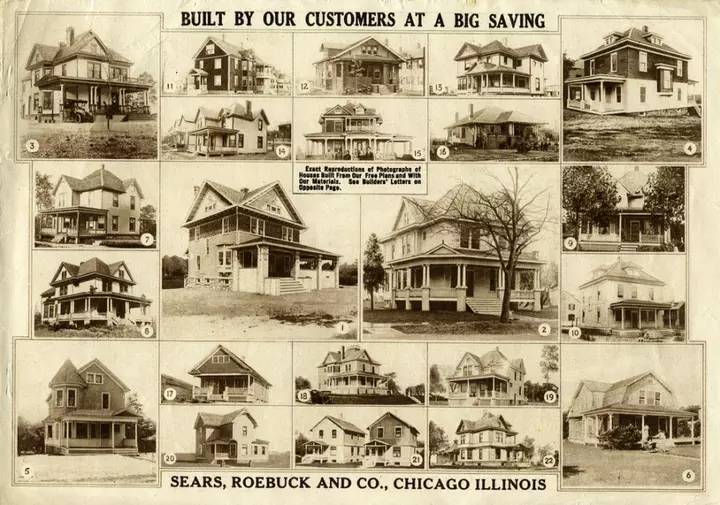
Two of the books that most shaped American culture both happened to bear the nickname “The Big Book.” While the second of these, the A.A. Manual, published in 1939, changed the country with 12-Step recovery groups, the first of these, the Sears Catalog, transformed America with mass consumption, offering customers in every part of the country access to modern conveniences and retail goods of all kinds at unheard of prices. Beginning in 1908, Sears started selling entire houses, in approximately 25-ton kits transported by railroad, consisting of 30,000 pre-cut parts, plumbing and electrical fixtures, and up to 750 pounds of nails.
Instead they may have taken the idea from another company called Aladdin. Aladdin houses have been forgotten, however, and even Sears’ main competitor, Montgomery Ward, didn’t catch up until 1921 and only lasted ten years in the kit house business. Sears houses, on the other hand, are celebrated and sought out as models of the early 20th century American home, and for good reason.
Between 1908 and 1939, Sears sold 70–75,000 houses in 447 different styles all over the country. These Sears homes weren’t cheap low-end houses. Many of them were built using the finest quality building materials available during that time.
It’s not uncommon to find Sears homes today with oak floors, cypress siding, and cedar shingles. What’s even more extraordinary is that 50% of these were built by the homeowners themselves, usually, as in a barn-raising, with the generous help of family, friends, and neighbors. The other half sold were built professionally.
Not only could potential buyers see firsthand, and participate in, the construction. They could also order the same or a similar model, customize it, and even—as the company tells us in its own short history of the “Sears Modern Home”—design their own homes and “submit the blueprints to Sears, which would then ship off the appropriate precut and fitted materials.” Sears sounds modest about its impact. The company writes it was not “an innovative home designer” but instead “a very able follower of popular home designs but with the added advantage of modifying houses and hardware according to buyer tastes.” Yet Sears houses aren’t beloved for their forward-looking designs, but for their sturdiness and variety, as well as for their impact on “the emotional lives of rural folk,” as Messy Nessy puts it.
In its first year of production, 1908, Sears sold only one model, number 125, an Eight-Room Bungalow Style House for $945, advertised as “the finest cottage ever constructed at a price less than $1500.” In 1918, the company moved from a numbering system to named models, most of which sound like the names of cozy small towns and bedroom communities: Adeline, Belmont, Maplewood, Avalon, Kilbourne, Del Ray, Stone Ridge…. (See a full list of these models at The Arts & Crafts Society website.) In the years Sears sold houses, between 54 and 44 percent of Americans lived in rural areas, and these constituted Sears’ most loyal customers, given that the catalog allowed them to purchase things they could buy nowhere else, including ten room colonial mansions like The Magnolia, available from 1913 to 1922 for $6,488, or roughly $88,000—a steal if you can put in the work. This was the largest and most expensive model the company offered, “a three-story, eight room neo-Georgian with a two-story columned portico, porte-cochere, and sleeping porches.” (Mint juleps and servants’ quarters not included.) Sears eventually offered three build qualities, Honor Bilt, Standard Built, and Simplex Sectional. At the lowest end of the price and build spectrum, the company notes, “Simplex houses were frequently only a couple of rooms and were ideal for summer cottages.” Many of its low-end and early models did not include bathrooms, and the company sold outhouses separately.
Extract — continue reading at the source.