The universe was born in a rapid explosion of energy known as the Big Bang some 13.8 billion years ago. For the first 380,000 years, the universe was hot, dense soup: a relatively simple mix of negatively charged electrons and nuclei of the elements hydrogen and helium. But then, darkness descended.
The universe cooled, allowing the electrons to join the hydrogen and helium, which coalesced into a neutral cloud of gas. Without an abundance of free electrons to scatter leftover energy from the Big Bang—and no stars or galaxies to give off light—the universe plunged into a period called the cosmic dark ages. While scientists have a good understanding of the Big Bang and its immediate aftermath, this second phase is less clear.
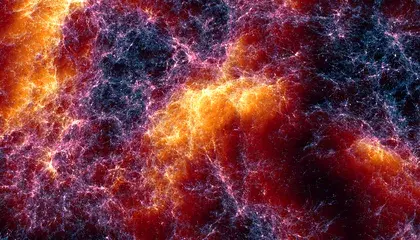
Now, a new computer simulation built by researchers at the Center for Astrophysics, Harvard & Smithsonian, and other institutions is shedding light on this cloudy chapter of the early cosmos, and how the universe broke free of it. The team published their work in the November issue of the Monthly Notices of the Royal Astronomical Society. The simulation, dubbed Lumina, is one of the largest and most detailed models of the cosmic dark ages yet, spanning from 50 million to 200 million years after the Big Bang.
It covers more than 100 times the volume of comparable simulations, according to a statement. Astrophysicists can use the model alongside new observations from the James Webb Space Telescope (JWST) and the new Nancy Grace Roman Space Telescope to test theories on the early formation of the universe. This transition phase, which ended the cosmic dark ages, was driven by electrons being pulled away from hydrogen and helium, creating charged particles, or ions.
This happened in two waves: First, as structures formed and energy coalesced into the first stars a few hundred million years after the Big Bang, their light removed hydrogen’s electron, turning the neutral atoms into free electrons and positively charged protons, Zier says. Ionization of helium, which has two electrons, proved harder. Starlight was powerful enough to dislodge the element’s first electron, but it took more radiation from developing supermassive black holes to remove the second.
The simulation also showed this process did not occur evenly across the cosmos. To produce this, the team used the Frontier supercomputer at Oak Ridge National Laboratory. At its peak, the project used about 600 terabytes of memory, roughly the storage space needed for 150,000 high-definition movies.
Extract — continue reading at the source.