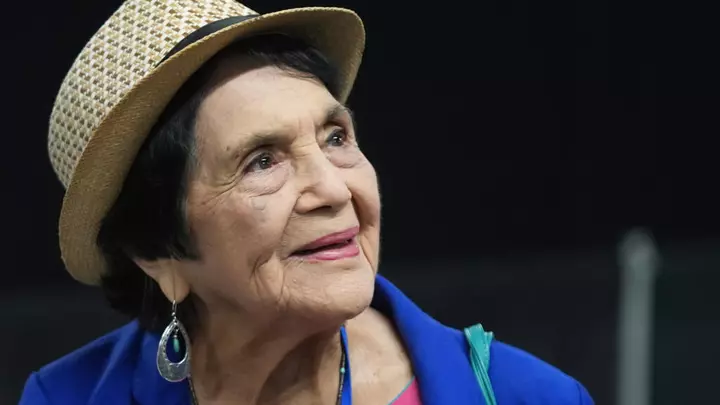
Dolores Huerta, who co-founded the United Farm Workers (UFW) union with Cesar Chavez and fought legislators and powerful growers in the US to improve the lives of a previously powerless constituency, died of cancer on Wednesday at the age of 96, a family spokesperson said. Huerta was one of the foremost women in US labour history, serving the UFW as chief negotiator, strike organizer, lobbyist and reformer during its heyday in the 1960s and '70s in California's agriculture-rich Central Valley. Read moreUS heatwave pushes agricultural workers to work at night: 'Even so, it's horrible' Thanks to the contracts the UFW negotiated, farmworkers won job security, healthcare, retirement plans, a credit union and job-specific benefits such as guaranteed rest periods, toilets in the fields, clean drinking water and protection from pesticides.
Huerta was credited with giving the UFW its slogan "Si, se puede", the loose translation of which, "Yes, we can", was later used by Barack Obama during his successful 2008 presidential campaign. She remained a regular on the college lecture circuit into her 90s, speaking out against the immigration policies of President Donald Trump. During elections she travelled the country, endorsing candidates and registering voters.
Read moreFamed union leader Dolores Huerta urges US to mobilise against Trump UFW co-founder Chavez, who died in 1993 and was the face of the organisation, was a seventh-grade dropout and former grape picker with a man-of-the-soil appeal who espoused the non-violent philosophies of Gandhi and Martin Luther King Jr, with a nod to Emiliano Zapata, a leader of Mexico's peasant revolution in the early 20th century. But Chavez had a dark side. In 2026, Huerta was one of a number of women who came forward with accounts of how they had been sexually assaulted by him, in some cases when they were minors.
Huerta said that he had pressured her into having sex one time, and another time raped her. Both encounters resulted in pregnancies, and Huerta said she arranged for the babies to be raised by others. Read moreCesar Chavez, icon of US labor movement, accused of serial sex abuse While Chavez was recruiting, going on well-publicised hunger strikes and being embraced by liberal lawmakers and celebrities, the diminutive, college-educated Huerta handled negotiating with growers, lobbying legislators and other business for the UFW.
She was arrested more than 20 times, subjected to death threats and other harassment. She suffered broken ribs and a damaged spleen when beaten by baton-wielding San Francisco police in a 1988 protest against the policies of George HW Bush during his presidential campaign. In an interview with PBS in 2012, before the assault accusations against Chavez came to light, Huerta said she had been fine with him taking the spotlight as she wanted to focus on helping people rather than gaining fame.
"He said, 'One of us is going to have to be the spokesperson. Are you all right if I'm the spokesperson?' Of course, I said yes." Huerta was born in Dawson, New Mexico, to a Mexican immigrant family, and spent much of her youth in Stockton, California, after her parents divorced. Her father was a miner, labourer, union activist and state lawmaker; her mother raised three children while buying and running a hotel for low-income people in Stockton.
Extract — continue reading at the source.