When corals need to recover from bleaching, they should touch a healthy clone, according to new research. Lab experiments suggest that bleached coral can bounce back within weeks of coming into physical contact with a colorful, genetically identical piece of itself. While the remarkable healing method, published on October 14 in the journal Science Advances, likely can’t restore all the world’s sick corals on its own, the discovery could help inspire new recovery strategies.
Polyps in one colony have the same genetics, meaning they are clones of one another. When their watery environment gets too warm too fast, corals lose the colorful, beneficial algae in their tissues that provide energy. Without these vital partners, corals starve, are susceptible to harmful algae, and grow pale—hence the term bleached.
Total recovery, if possible, can take months to years. But in 2025, study co-author and Stanford marine scientist Steve Palumbi stumbled upon a strange possible cure. A healthy hunk of coral had accidentally tipped over and was touching a bleached piece from the same colony in a laboratory tank.
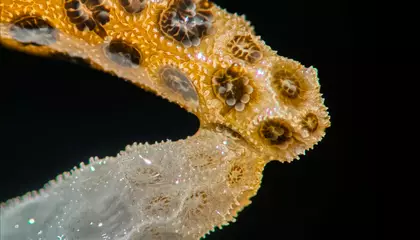
At their point of contact, the pale fragment had regained its color, meaning the beneficial algae had returned. Meanwhile, Collins had been brainstorming about how dangerous bacteria can enter corals when contaminated materials, like plastic debris, touch them. He wondered if researchers could leverage this phenomenon to help corals instead.
Half were set up so the sick and healthy fragments were touching, while the others had a millimeters-wide gap between the two branches. All bleached corals touching healthy clones fully healed within seven weeks, but the bleached fragments in non-touching pairs fared poorly, and some died. Taking a closer look under a high-powered microscope revealed that physical contact between two coral clones allowed them to align little channels in their tissues.
The healthy coral could then send beneficial algae and nutrients to the stressed one. The team saw transferred material in sick corals after just three days of contact. What’s more, the fragments didn’t have to touch for the entire duration of the recovery.
Extract — continue reading at the source.