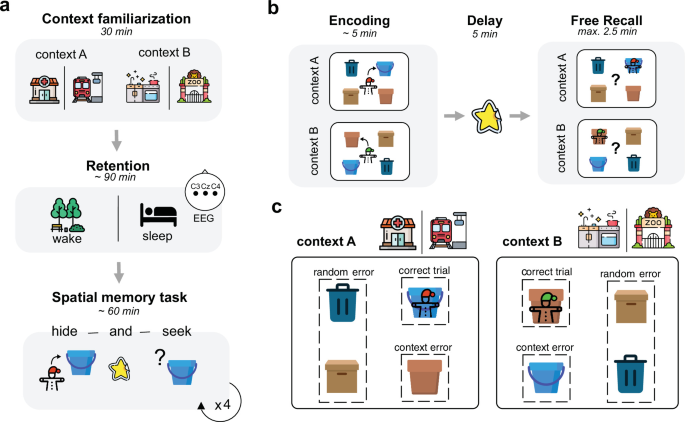
Sleep consolidates episodic memory through a hippocampus-dependent process in adults. Whether and how sleep supports memory consolidation during early life, when hippocampal function is immature, remains unclear. Here, we examined effects of sleep on the consolidation of spatial context, a core component of episodic memory, in toddlers aged 2–3 years.
Toddlers were familiarized with two spatial contexts, followed by a ~ 90-min nap or equivalent wake period. Afterwards, using a hide-and-seek game we tested their ability to relocate toys within these contexts. Only after post-familiarization sleep, toddlers showed significant context memory and formed stronger associations between toys and specific contexts compared to wakefulness.
Contextual memory was positively correlated with spindle density and slow oscillation–spindle phase-amplitude coupling during non-rapid eye movement sleep. Here, we show that, despite hippocampal immaturity, memory effects in the sleeping toddler’s brain are accompanied by thalamo-cortical oscillatory dynamics that are also implicated in adult memory consolidation. Sleep supports memory formation through a hippocampus-dependent consolidation process1,2,3,4,5.
This consolidation process is thought to originate from the repeated replay of newly encoded hippocampal representations during non-rapid eye movement (NonREM) sleep, driven by ripples in the hippocampus and cortex6 (~100 Hz). These ripples are thought to group cofiring within widespread cortical sites during time windows of neural plasticity that are defined by cortical down-to-upstate transitions (i.e. slow oscillations (SOs) with
Extract — continue reading at the source.


