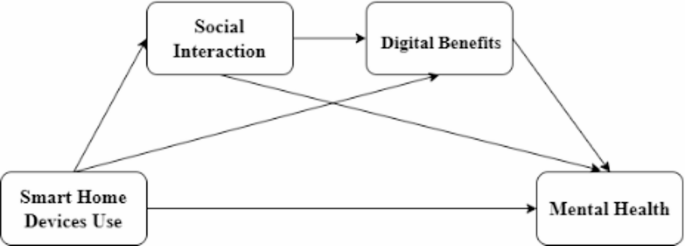
This study examines how smart home device use influences older adults’ mental health over time. Using three waves of the China Longitudinal Aging Social Survey (2018, 2020, 2023), we constructed a balanced panel of 4,541 adults and applied hierarchical regression and PROCESS Model 6 with 5,000 bootstraps. Results show that smart home device use is positively associated with subsequent mental health.
However, after accounting for mediators, the direct association is no longer significant, indicating the effect is mainly indirect. Both social interaction and digital benefits mediate this association, with a sequential pathway from social interaction to digital benefits also supported. Subgroup analyses reveal stronger links among urban and higher-educated groups.
These findings suggest that smart home technologies may promote mental health primarily by enhancing social engagement and perceived digital convenience, informing the integration of these technologies into aging-in-place and healthy aging strategies. With the acceleration of population aging, later life is increasingly characterized by declining physical functioning, a growing burden of chronic diseases, higher risks of falls, and greater dependence on the home environment. In China, more than 90% of older adults prefer to age in place1, underscoring the central role of the home setting in maintaining their quality of life.
Existing research shows that the most pressing areas in which older adults require support include health monitoring, emergency response, environmental safety, behavioral management, social engagement, and the organization of daily affairs2. Smart home devices use (SHDU) aligns closely with these needs by enabling environmental sensing, remote reminders, safety monitoring, and automated assistance, thereby reducing daily risks and alleviating caregiving burdens3. In recent years, scholars have increasingly regarded SHDU as an important “environmental resource” that compensates for cognitive and physical decline and supports independent living.
Its significance extends beyond technological innovation and lies in its deep integration with older adults’ daily routines, health conditions, and social needs4. Empirical studies have shown a growing uptake of home technologies equipped with health‑management and safety‑monitoring functions among older adults5, indicating a shift from mere technology adoption to incorporation into everyday life. Understanding the value of SHDU requires consideration of functional needs, changing family structures, and emotional security (Tian et al.6,.
Therefore, situating SHDU within the broader contexts of aging‑related needs, age‑friendly housing, compensatory aging theories, and digital‑health policies is essential, although this perspective remains underdeveloped in the existing literature. Despite the considerable potential of SHDU in later-life contexts, much of the current research has concentrated on technology‑related dimensions such as acceptance, usage attitudes, design features, and usability7,8. While these studies provide important insights into human–technology interactions, they offer limited evidence on whether SHDU can meaningfully improve older adults’ quality of life and psychological well‑being.
Extract — continue reading at the source.