/https://tf-cmsv2-smithsonianmag-media.s3.amazonaws.com/filer_public/be/ed/beed2eb4-3ffa-47b5-834a-c8f00d6901ea/original_1.webp)
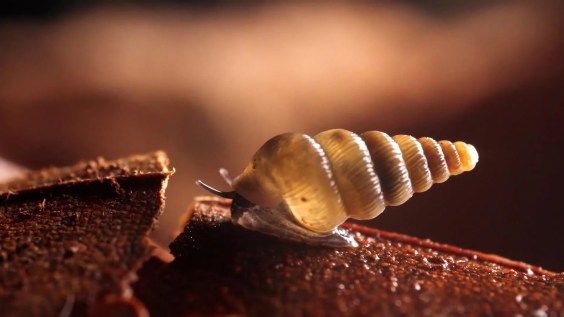
Snails are famous for their slime, leaving trails of it wherever they go. But this mucus does more than make a mess. It’s a multipurpose tool whose texture can be tweaked to be slippery, sticky, foamy or even hard depending on the needs of the mucus master.
Now, scientists say they’ve figured out how land snails manipulate their slime. The shell-dwelling critters can change the proportions of collagen and calcium to alter their mucus’ mechanical properties, researchers report in a study published August 6 in the journal Science. The findings could help pave the way for all sorts of new, useful materials.
Letting the snails roam around in a glass bowl left behind a trail of slick, lubricant mucus, while gently detaching the gastropods from terrarium walls resulted in globs of sticky, adhesive mucus. Prodding the creatures’ shells made the animals secrete two types of defensive slime: one foamy and another yellow and thick. The team also collected hardened mucus membranes, called epiphragms, that snails use to cover their shell openings during hibernation.
Analyzing the mucus varieties’ molecular makeup revealed that each is made of largely the same types of proteins, but the amounts differ based on the slime’s purpose. For instance, the lubricant mucus is 0.3 percent protein while the thick, yellow defense mucus is about 4 percent protein. The main structural protein is collagen VI, the team found, which is well known for roles in human skin, bones and joints.
What’s more, looking at the slimes with a high-powered microscope and with a laser revealed that calcium content also depends on mucus type. Calcium ions—electrically charged atoms—can interact with proteins and change the slime’s density, the team found. The element seems to be stored as granules of calcium carbonate in the snails’ mucus-secreting tissue, so the gastropods can add calcium to the substance as needed.
The grains can donate calcium ions for wet mucus varieties or serve as a mineral precursor for dry mucus types, like the epiphragm. In 2014, however, experts found a small group of the creatures in Bermuda’s capital. They were carefully bred, and earlier this year, conservationists announced the species was safe from extinction after releasing more than 100,000 individuals into the wild.
Extract — continue reading at the source.