Elephants use low-frequency rumbles to communicate among individuals. Rumbles occur in several patterns: as discrete, non-overlapping calls, in antiphonal sequences where individuals alternate vocalizations, and in choruses where multiple individuals produce overlapping calls. Despite the wide availability of bioacoustics tools, most studies focus on non-overlapping signals rather than on choruses.
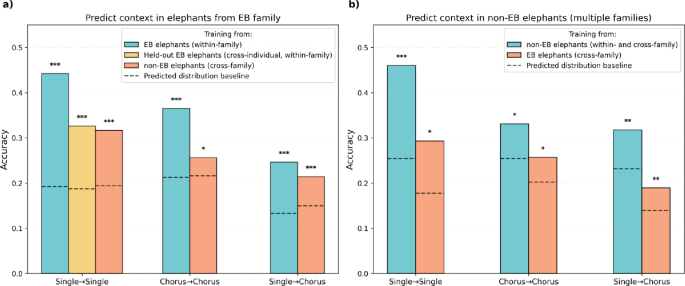
Here, we address this gap by investigating multi-caller rumble choruses recorded in several behavioral contexts. We show that behavioral context can be predicted from single (i.e., non-overlapping) and from overlapping, chorused rumbles. We find that individual rumbles in a chorus share structural similarities with single rumbles used in the same behavioral context, suggesting that choruses are composed of context-matched individual elements that together form a distinct multi-caller signal.
We also find that the rumbles within choruses converge acoustically in particular behavioral contexts. Lastly, we find that the rumbles associated with various contexts vary systematically among individuals and family groups and suggest that individual acoustic differences may account for the observed family-level variation. Our findings extend previous work showing that rumbles encode behavioral context and caller identity, providing novel evidence that elephant choruses function as group signals encoding context through both their composition and patterns of acoustic convergence.
Social species often use vocal communication to coordinate collective behaviors and mediate complex social interactions. Most studies of non-human vocal communication analyze calls as discrete units within vocal exchanges, and comparatively few have investigated the acoustic structure of choruses where many individuals vocalize simultaneously (but see1). For animals that live in social groups, “choruses”, i.e., multi-caller, overlapping vocalizations, are common and serve diverse social functions.
For example, chimpanzees (Pan troglodytes) use chorused calling to regulate group dynamics during fission-fusion events2, sperm whales (Physeter macrocephalus) communicate in overlapping codas which are thought to reinforce social bonds between individuals3, groups of male Atlantic spotted dolphins (Stenella frontalis) produce overlapping whistles when forming coalitions against competitors4, and communally breeding cuckoos (Crotophaga major) perform group choruses that can support group formation and may play a role in collective decision making5. Like single calls, choruses may also contain acoustic signatures of identity. For example, green woodhoopoe (Phoeniculus purpureus) rallies (choruses of multiple group members calling simultaneously) are distinct at the group level and can be used by woodhoopoes to discriminate between neighbor and stranger groups6.
Acorn woodpeckers (Melanerpes formicivorus) can determine whether two chorusing individuals belong to the same group as each other, likely by recognizing each individual caller within the overlapping chorus7. Given the prevalence of chorusing across taxa and its use in complex social interactions, the dynamics and patterns of overlapping multi-caller exchanges likely encode important social information in many species. Vocal convergence, in which individuals modify their vocalizations to become more acoustically similar during interactions, has been observed in several species and shown to serve diverse functions across taxa.
Extract — continue reading at the source.


