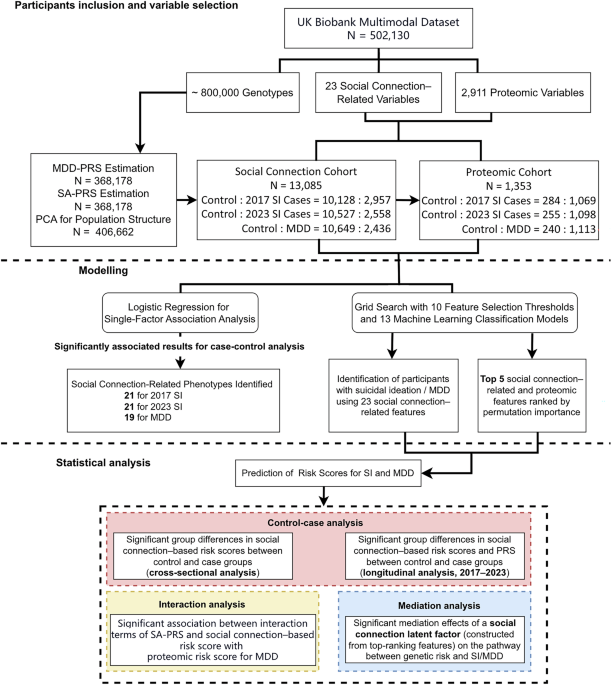
Suicidal ideation (SI) and major depressive disorder (MDD) are complex psychiatric conditions arising from the interplay of genetic liability, molecular processes, and psychosocial factors. While these dimensions have been extensively studied in isolation, their joint contribution to SI and MDD remains unclear. This study integrates multi-modal data to elucidate these synergistic effects and develop robust models for individual-level risk stratification.
Leveraging longitudinal multi-modal data from 13,085 UK Biobank participants, we integrated genomic, proteomic, and social connection profiles. We developed interpretable risk scores using a rigorous supervised machine learning framework encompassing diverse linear and ensemble classifiers. Permutation importance was employed to quantify feature contributions and derive transparent, weighted risk metrics across diverse classifiers.
These scores were validated through association, interaction, and mediation analyses. Social connection-based risk scores significantly differentiated cases and controls across the two suicidal ideation phenotypes at 2017 and 2023 with cross-sectional analyses (AUCs: 0.70 - 0.73), outperforming proteomic-only models. Functional dimensions of social connection emerged as the most informative predictors.
Longitudinal analyses revealed that social risk scores at baseline predicted suicidal ideation onset six years later, independent of demographic covariates. Interaction analyses demonstrated that polygenic risk for suicide attempt significantly interacted with both social and proteomic risk features in relation to depression. Structural equation models further confirmed that social disconnection acts as a key mediator linking genetic predisposition to MDD and SI.
Social disconnection is a critical risk factor mediating the impact of genetic vulnerability on psychiatric outcomes. Integrating social, genetic, and molecular data supports a multilevel framework for risk stratification and highlights the potential of socially oriented interventions to mitigate biological risk. Suicide and major depressive disorder (MDD) are major global public health challenges, with disproportionate burdens on middle-aged and older adults.
Suicide rates in these age groups are among the highest globally and continue to rise, particularly in high-income countries [1, 2]. In contrast to younger populations, older adults are less likely to show suicidal intent, thereby complicating timely recognition and intervention [3]. Suicidal ideation (SI), the earliest and most modifiable point on the suicide spectrum, serves as a powerful predictor of suicide attempts and completions [4].
Extract — continue reading at the source.