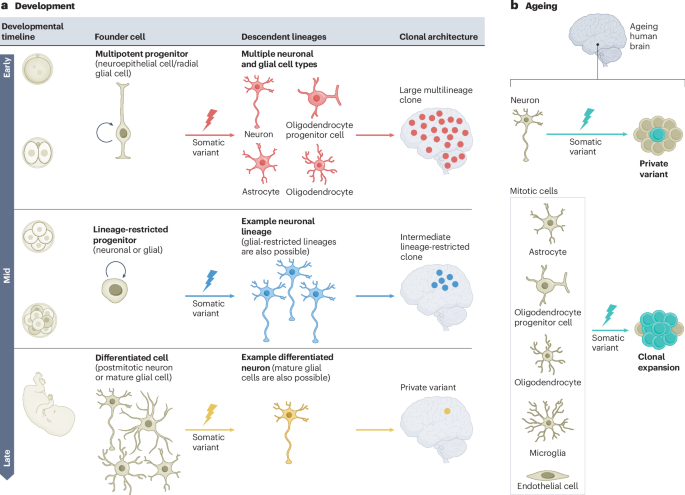
Somatic mosaicism is increasingly recognized as a pervasive feature of the human brain and a potential contributor to neurological disease across the lifespan. Unlike germline variants, somatic variants arise post-zygotically and are unevenly distributed across regions, cell types and even individual neurons, enabling focal biological effects that can scale to network-level dysfunction. In this Review, we synthesize current evidence that developmental timing, clonal architecture and cell-type-specific selective pressures shape how somatic variants influence brain structure and function.
Early embryonic variants can produce broad regional clones and severe phenotypes, whereas later events are usually more restricted; with ageing, ongoing DNA damage and imperfect repair generate private variants that might cumulatively reduce cellular resilience. We also summarize advances in detection approaches, including bulk, error-corrected and single-cell sequencing, and discuss their strengths and current limitations for clinical translation. Emerging data link brain somatic variants to neurodevelopmental and neurodegenerative phenotypes, supporting a unified framework in which mosaic genetics bridges focal lesions and distributed neurological syndromes.
Integrating genomic, cellular and physiological analyses in longitudinal human studies will be essential to define causality, identify biomarkers and guide future targeted interventions. Somatic mosaicism is a pervasive feature of the human brain, arising across development and ageing, and generates diverse clonal and private variant patterns that shape regional and cellular heterogeneity. Developmental timing determines clonal architecture: early variants produce widespread regional clones, whereas later occurring variants generate focal lesions, linking mosaic genetics to anatomical and clinical phenotypes.
Ageing-associated mutagenesis accumulates in neurons and glia, driven by DNA damage and repair processes, and might progressively reduce cellular resilience and increase vulnerability to neurodegeneration. Neurodegenerative diseases exhibit increased neuronal somatic variant burdens with shared mutational signatures, implicating oxidative stress and topoisomerase 1 (TOP1)-mediated DNA repair as convergent mechanisms of genomic instability. Clonal expansion of microglia carrying clonal haematopoiesis (CHIP)-associated variants represents a distinct axis of somatic mosaicism, contributing to inflammatory states and potentially influencing neurodegenerative disease progression.
Somatic variants confined to disease-relevant brain regions could act as focal initiating lesions, triggering pathology that propagates across anatomically connected brain regions and drives progressive neurodegeneration. This is a preview of subscription content, access via your institution Access Nature and 54 other Nature Portfolio journals Get Nature+, our best-value online-access subscription Receive 12 print issues and online access Prices may be subject to local taxes which are calculated during checkout Lindahl, T. Instability and decay of the primary structure of DNA.
Nature 362, 709–715 (1993). Helleday, T., Eshtad, S. & Nik-Zainal, S. Mechanisms underlying mutational signatures in human cancers.
Extract — continue reading at the source.


