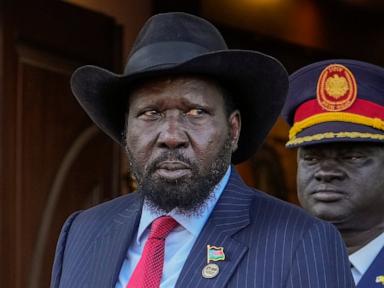
South Sudan President Salva Kiir has dissolved his country’s transitional government ahead of upcoming elections JUBA, South Sudan -- JUBA, South Sudan (AP) — South Sudan President Salva Kiir dissolved his country's transitional government, removing his deputies and introducing a caretaker administration ahead of elections on Dec 22. The changes outlined in an executive decree were announced on state television Tuesday night. The order also dissolved the national legislature, the country's 10 state governments and their assemblies, as well as authorities in three administrative areas.
Kiir, who will remain president throughout the electoral period until a new president is sworn in, appointed caretaker ministers to oversee key ministries including foreign affairs, defense, cabinet affairs, interior, justice, national security, finance, petroleum, information and peace building. The transitional period and implementation of a 2018 peace agreement, which ended a deadly civil war, has been extended several times. The transitional government's dissolution was envisaged as part of the road map to elections.
In previous orders, Kiir has alarmed observers by dismissing important officials. He fired the National Elections Commission chairperson on Sept. 15 without publicly giving a reason. Kiir suspended Riek Machar as South Sudan's first vice president last year after justice authorities filed criminal charges over Machar’s alleged role in an attack on a garrison of government troops.
Machar's treason trial is ongoing, and he denies the charges. Kiir is expected to be on the presidential ballot. It is not clear if Machar, who is under house arrest, will be a candidate.
Amnesty International said the dissolution of the transitional government marks a decisive step toward South Sudan’s first elections but urged authorities to protect civic space and human rights during the electoral period. The rights group called on authorities to guarantee freedom of expression, association and peaceful assembly and to end what it described as intimidation of journalists, civil society actors and political opponents. Abraham Awolich, a policy analyst in South Sudan, said the entire process violates the 2018 peace agreement when done “in one stroke without a new political settlement.” “The elections are nothing close to being democratic, free and fair elections.
They are very much a smoke screen for the consolidation of a dictatorship and one-man rule,” he said. Awolich warned Kiir's unilateral decisions have pushed the country to the brink of war and political and constitutional crises, calling for the convening of an all-inclusive, internationally mediated national political dialogue open to all political forces inside and outside the country, including civil society. The United Nations Commission on Human Rights in South Sudan said earlier this month that elections without safeguards and inclusive political dialogue could fuel renewed conflict. 24/7 coverage of breaking news and live events
Extract — continue reading at the source.